
If you're looking for a European alternative to Confluence, the important questions are who operates the service, where your data is stored, and how much of your existing workspace you can bring across.
Atlassian is also phasing out Confluence Data Center. Support ends on March 28, 2029, giving teams that run Confluence on their own infrastructure a deadline to plan their next move.
We compared six European products, including hosted team wikis, self-hosted enterprise platforms, and collaboration tools that also manage tasks and issues.
What counts as a European Confluence alternative?
We used two criteria to select the tools for this list:
-
European provider: The company or service operator must be headquartered and incorporated in Europe. We include the EU, other EEA countries, Switzerland, and the UK.
-
Relevant functionality: The product must cover a meaningful part of a typical Confluence setup, such as collaborative pages, company wikis, technical documentation, or structured knowledge management.
European ownership and European data hosting are separate considerations. We checked the operating company, infrastructure location, and subprocessors for each product.
How we evaluated these Confluence alternatives
We used the same four Confluence scenarios to assess the products: an onboarding guide, meeting notes, a restricted policy page, and a project page linked to related documentation.
- Editing and organization. We reviewed how each product handles pages, links, comments, search, permissions, and version history using official product documentation and demos.
- Migration. We checked the available Confluence import tools, supported export formats, and documented limits around attachments, macros, history, and permissions.
- Provider and hosting. We verified company or service-operator details, deployment options, data hosting locations, and published subprocessors.
- Pricing. We compared published plans, user limits, and additional hosting or support costs in November 2026.
This article is published by Nuclino, which is included in the comparison.
European Confluence alternatives at a glance
| Tool | Country | Best for | Deployment | Confluence migration | Starting price |
|---|---|---|---|---|---|
| Nuclino | Germany | Team wiki and lightweight issue tracking | Cloud | Built-in HTML import | Free; $6/user/mo |
| XWiki | France | Enterprise wiki and self-hosting | Cloud or self-hosted | Migration toolkit | Free self-hosted |
| Stackfield | Germany | Docs, projects, and chat | German cloud or on-premises | No dedicated importer documented | €9/user/mo |
| BlueSpice | Germany | Controlled docs and approvals | German cloud or self-hosted | Migration tool and services | Free; cloud €1,350/year |
| Papyrs | Netherlands | Company wiki and intranet | EU cloud | No dedicated importer documented | €80/month for 20 users |
| Elium | Belgium | Knowledge review and AI search | EU cloud; enterprise on-premises | Import tools and assisted migration | €15/user/mo (10 min.) |
Prices shown are starting rates with annual billing where applicable, excluding tax. Self-hosted software may have additional infrastructure or support costs.
1. Nuclino
- Best for: Team wikis and lightweight project or issue tracking
- Country: Germany
- Pricing: Free plan; Starter from $6/user/month with annual billing
- Deployment: Cloud, with primary customer data hosted in Europe
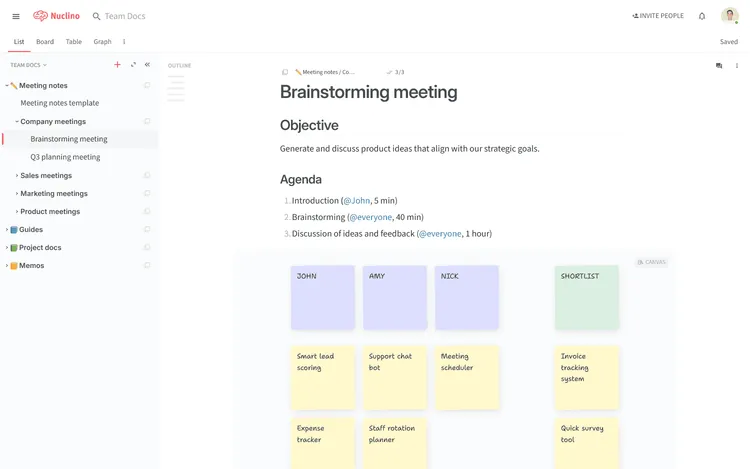
Nuclino is built by Nuclino GmbH, an independent company based near Munich. Its workspaces combine internal documentation, meeting notes, project knowledge, and issue tracking.
Content is organized into workspaces, collections, and items, with list, board, table, and graph views. A bug or feature request can have an assignee, priority, and due date, while its item holds the description, related documents, and discussion. This allows smaller teams to maintain a wiki and track issues in the same workspace.

For existing Confluence content, Nuclino has a built-in import option. Nuclino can import a Confluence HTML export directly, including a complete space exported as a ZIP file. The importer is available on all plans.
Nuclino is a cloud service. Its current subprocessor list says the main infrastructure providers store customer data in Europe, though some subprocessors are US companies. Organizations with strict requirements around provider jurisdiction should review that list.
The free plan allows up to 50 items. Starter costs $6 per user per month when billed annually.
Main limitation: Complex Confluence macros and formal document approval workflows may require XWiki or BlueSpice. Nuclino's issue tracking is geared toward lighter backlogs; teams needing extensive Jira automation should check those requirements separately.
2. XWiki
- Best for: Self-hosted enterprise knowledge bases and complex Confluence migrations
- Country: France
- Pricing: Free Community edition; paid cloud and support plans vary by team size
- Deployment: Cloud or self-hosted
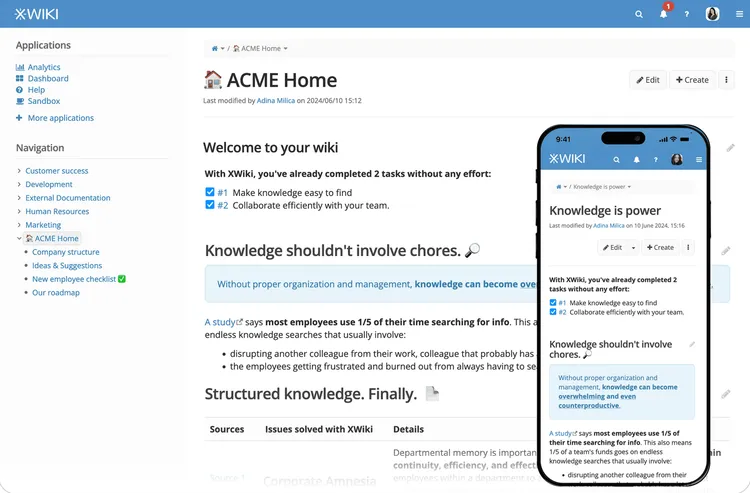
XWiki is one of the closest European replacements for Confluence in scope. XWiki SAS is registered in Paris, employee-owned, and has been developing the open-source platform since 2004.
XWiki provides page hierarchies, templates, macros, and permissions at different levels of the wiki. Teams can add structured content and custom applications, and larger deployments can divide documentation into separate sub-wikis. These options give administrators considerable control over how content is organized.
Moving from Confluence is one of XWiki's better-documented workflows. Its migration tooling supports Confluence export packages and can move pages, attachments, users, permissions, metadata, and page history. The paid Migration Toolkit also includes compatibility macros. XWiki documents cases where some macros or permission rules require attention after migration.
Configuring extensions, structured data, and detailed access rules takes administrative time, especially in a self-hosted deployment.
XWiki can run on your own infrastructure or in XWiki Cloud. The company says its cloud service is hosted in Europe, and its public legal information lists OVH in France as the host.
Main limitation: Extensive configuration can be difficult to maintain without technical expertise. The more complete Confluence migration tooling is part of paid support packages.
3. Stackfield
- Best for: Teams that want secure documentation alongside project management and chat
- Country: Germany
- Pricing: Starter from €9/user/month with annual billing
- Deployment: German cloud or on-premises
Stackfield is developed by Stackfield GmbH in Munich. It combines documentation, tasks, files, and team communication in shared rooms, with end-to-end encryption and data hosting in Germany.
Stackfield's Pages module supports text, tables, images, attachments, inline comments, and version history. Pages can be organized in folders and found through search.
Pages sit alongside tasks and conversations in shared rooms. Updating a document involves saving a draft or publishing a new version, with statuses such as Needs Review and Final to manage reviews. The wider workspace includes Kanban boards, Gantt charts, chat, and workflows.
Cloud plans start at €9 per user per month with annual billing, although Starter is limited to 10 users and three rooms. Business starts at €14 per user per month. Stackfield also offers on-premises deployment starting at €28 per user per month with a 100-user minimum.
Main limitation: Pages are organized around rooms, and Stackfield has fewer wiki-specific features than XWiki or BlueSpice. We could not find a dedicated Confluence importer, so transferring a large existing wiki would require additional work.
4. BlueSpice
- Best for: Controlled documentation, quality management, and approval workflows
- Country: Germany
- Pricing: Free edition; BlueSpice pro Cloud starts at €1,350/year for up to 25 users
- Deployment: German cloud or self-hosted
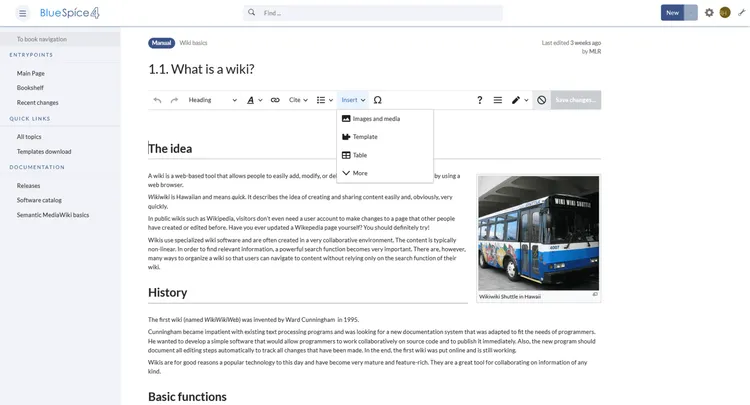
BlueSpice is developed by Hallo Welt! GmbH in Regensburg. It builds an enterprise knowledge platform on top of MediaWiki, adding features that are useful in company documentation: visual editing, permissions, metadata, forms, versioning, workflows, approvals, read receipts, and book-style manuals.
BlueSpice is particularly relevant when documents need a defined review process. A policy can move through drafting and approval, retain metadata and revision history, and use read confirmations to track acknowledgment. Those controls are useful for regulated procedures and internal manuals.
BlueSpice also publishes a specific Confluence migration route. The vendor provides a migration tool and also warns that specialized macros and existing space structures may need custom handling. A migration plan should account for those exceptions.
The cloud edition is hosted by Hetzner in Nuremberg and Falkenstein, Germany. BlueSpice can also run on your own servers, with Docker as the standard on-premises deployment.
Main limitation: The interface and administration are heavier than Nuclino or Papyrs. Teams mainly looking for quick collaborative notes may find the governance features excessive.
5. Papyrs
- Best for: A simple company wiki or intranet with predictable pricing
- Country: Netherlands
- Pricing: Team Wiki from €80/month with annual billing for up to 20 users
- Deployment: Cloud
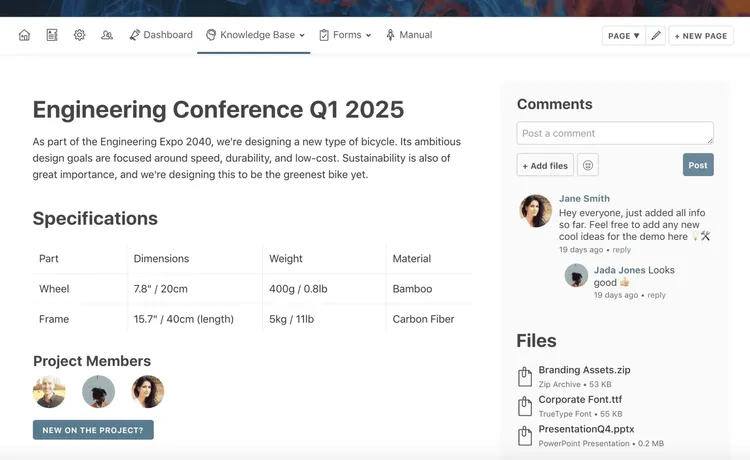
Papyrs comes from Stunf B.V. in Eindhoven. It combines wiki pages with intranet features such as forms, checklists, calendars, polls, employee directories, and separate subsites for teams or topics.
Pages are assembled with drag-and-drop widgets. Separate subsites allow departments to maintain their own information, such as HR policies or project updates. Search, permissions, version history, and Markdown editing are included.
Its pricing is unusual for this category. Papyrs charges per site and user tier instead of a fixed per-user rate. The Team Wiki plan is €80 per month with annual billing for up to 20 users, while Company Wiki is €319 per month for up to 60.
Papyrs says customer data is stored in data centers in the Netherlands, Germany, Finland, and Ireland. The company is incorporated in the Netherlands.
Main limitation: Papyrs has no self-hosted edition and we could not find a dedicated Confluence importer. A larger migration will need more manual work than with Nuclino, XWiki, or BlueSpice.
6. Elium
- Best for: Knowledge that needs owners, review cycles, and AI search
- Country: Belgium
- Pricing: Team from €15/user/month with annual billing, minimum 10 users
- Deployment: EU-hosted cloud
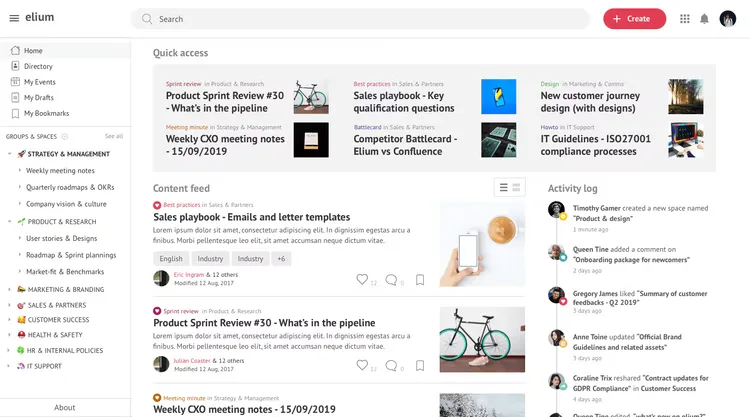
Elium takes a more managed approach to company knowledge. Teams can assign content owners, set review and expiry dates, and track how knowledge is used. Higher plans add approval workflows, usage analytics, and duplicate detection.
Expiry reminders bring outdated pages back to their owners for review. Corporate plans introduce approval workflows, while Elium's AI search answers questions using knowledge base content and provides links to its sources.
Elium is suited to larger organizations with recurring content review requirements. Its knowledge lifecycle features take priority over Confluence-style page trees and macros.
The Team plan starts at €15 per user per month with annual billing and a minimum of 10 users. Elium says the service is EU-hosted and ISO 27001 certified.
Main limitation: Pricing starts at a 10-user minimum. Elium offers import tools and assisted migration, but does not publicly document which Confluence-specific macros or permission settings it can preserve.
How to choose a European Confluence alternative
Start with the part of Confluence your team depends on most.
| If you need... | Start with... |
|---|---|
| A simple hosted company wiki | Nuclino, Papyrs |
| A self-hosted enterprise wiki | XWiki, BlueSpice |
| Formal reviews and approvals | BlueSpice, Elium |
| A documented Confluence migration path | Nuclino, XWiki, BlueSpice |
| Documentation with project and issue tracking | Nuclino, Stackfield |
| European cloud hosting with little setup | Nuclino, Papyrs, Elium |
Migration deserves its own test. Take one real Confluence space with nested pages, attachments, links, permissions, and at least one macro. Import it before signing a long contract.
The hard part is usually the content around the pages. Jira macros, Marketplace apps, custom templates, comments, permissions, and old links rarely map perfectly to another system. XWiki and BlueSpice publish the most detailed migration tooling, while Nuclino has the simplest built-in path for a standard HTML export.
FAQs
What is the best European alternative to Confluence?
For a company wiki with light project and issue tracking, Nuclino is a good starting point. It is a German company, has a built-in Confluence importer, and requires less setup than the enterprise wiki platforms. XWiki is a better fit when self-hosting, detailed permissions, extensibility, and a more complete migration path matter. BlueSpice is a good choice for controlled documentation and approval workflows.
Which European Confluence alternative is closest to Confluence?
XWiki and BlueSpice are the closest in terms of traditional enterprise wiki depth. Both support structured knowledge, permissions, extensions, self-hosting, and published Confluence migration options.
Are there self-hosted European Confluence alternatives?
Yes. XWiki, BlueSpice, and Stackfield offer self-hosted or on-premises deployment options. Elium offers on-premises hosting for enterprise customers. Stackfield has a 100-user minimum for its on-premises subscription. Self-hosting also means taking responsibility for updates, backups, monitoring, and recovery, unless a service provider handles those tasks.
Are there free European Confluence alternatives?
Nuclino has a free cloud plan with up to 50 items. XWiki and BlueSpice have free open-source editions that can be self-hosted. Stackfield offers a 14-day trial of its paid plans.
Which European alternatives can import Confluence?
Nuclino imports Confluence HTML exports directly. XWiki offers a dedicated Confluence Migration Toolkit, while BlueSpice publishes migration tooling and services. Elium offers general import tools and assisted migration, although its public documentation does not detail Confluence-specific import support. Test a representative space before committing to a migration plan.
Why are companies looking for European Confluence alternatives now?
The end of Confluence Data Center on March 28, 2029 is one reason to evaluate replacements. Provider jurisdiction, EU hosting, cloud costs, and the option to self-host are other common requirements.
