Unsure whether to choose Notion or Todoist? You've come to the right place.
Todoist has been around since 2007 and has earned a reputation as a tried-and-true task management tool. Notion, on the other hand, is still a newcomer in the field of productivity software, but it's already taking it by storm, gaining millions of users in a few short years.
The choice between Notion and Todoist is far from clear-cut. In this article, we will take a closer look at both Todoist and Notion and examine their strengths and weaknesses.
How we evaluated Notion and Todoist
We spent time using both Notion and Todoist and compared them across common workflows, such as daily task tracking, longer-term planning, organization, collaboration, and how easily tasks stay connected to notes and context. We also reviewed Capterra feedback to see which pros and cons show up most often.
This article is updated regularly to reflect product changes.
Notion vs Todoist: Key differences
The main difference between Notion and Todoist is how much structure they expect from you. Todoist focuses on helping you get tasks out of your head and into a clean, predictable system. Notion gives you a blank space where tasks live alongside notes, docs, and whatever else you want to build.
Todoist feels opinionated in a good way. You add a task, set a due date, maybe a priority, and you move on. It nudges you to stay consistent through recurring tasks, daily goals, and simple filters. The whole experience stays fast, even when your list gets long.
Notion works differently. Tasks are just another type of content. They can live inside project pages, meeting notes, or team docs. You can turn them into databases, add custom properties, and connect them to other pages. That flexibility helps when tasks need context, but it also means you have to decide how everything fits together.
A few practical differences that matter:
- Speed vs structure: Todoist stays quick and lightweight. Notion takes more time to set up, but it can hold much more than just tasks.
- Planning style: Todoist focuses on lists, priorities, and due dates. Notion supports bigger plans with notes, docs, and linked pages.
- Setup: Todoist works right away. Notion takes time to shape into something that fits your habits.
- Collaboration: Todoist supports basic team sharing and comments. Notion makes collaboration more visible by letting people work together inside the same pages.
- Flexibility: Todoist keeps things consistent across all users. Notion lets teams shape their own system, which can be helpful or confusing depending on what you want.
If you want a focused to-do app that stays out of your way, Todoist makes more sense. If you want tasks to live inside a bigger workspace with notes, docs, and shared context, Notion fits better.
Notion and Todoist comparison
Notion and Todoist share many similarities. Both tools allow you to easily manage your tasks, track your progress, and collaborate with your team.
However, despite the high-level resemblance, there are several fundamental differences that need to be kept in mind when making a decision. Let's dive deeper into what Notion and Todoist have to offer and also have a look at other alternatives you may want to consider.
Notion
- Pricing: Free, advanced features starting from $10/user/month
- Rating on Capterra: 4.7/5
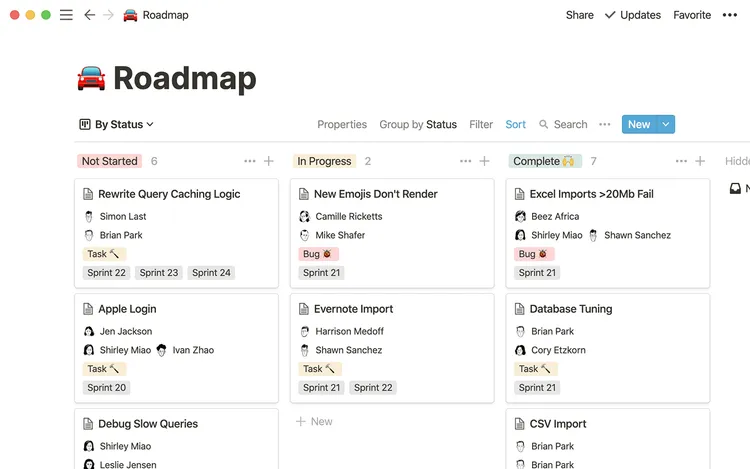
Initially designed to serve as a note-taking tool, Notion has come a long way since its early days. Today, it makes a bold claim of being an "all-in-one workspace" where teams can bring all their work together, replacing multiple other tools.
Notion has gained widespread popularity because of how versatile it is. Like Todoist, Notion allows you to manage your tasks using lists and Kanban boards, but that's just the tip of the iceberg. Notion offers a wide range of different ways to organize your tasks and docs, giving you nearly limitless possibilities — you can use it as a knowledge base app, collaborate on documents, manage your product roadmap, and even set up a website — and so much more.
The downside of this extensive range of features is that the learning curve can be steep. Users transitioning from Todoist to Notion may initially feel overwhelmed by the numerous menus and options and may require time to become familiar with the platform.
Why you might prefer Notion over Todoist:
- Notion is more flexible and customizable than Todoist, with a more extensive feature set.
- Notion can be used not only as a project management tool, but also as a wiki and a database, allowing you to replace not only Todoist, but also tools like Google Docs, Airtable, and more.
- Notion offers more extensive collaboration features.
- Notion offers more robust features for businesses and large enterprises, such as advanced permission management, SCIM API, and more.
What users say about Notion:
"Notion is my go-to day-to-day business tool that I cannot function without. It helps me manage so much data, easily, and turn that data into something useful AND I use templates to make it happen so I invest little time into seeing results. Notion has saved me hundreds of hours and many dollars by keeping my important info all in one place. Notion has replaced Airtable, Todoist, and Zoho, is less expensive, and keeps me focused rather than switching between different services to accomplish one thing. Notion has a learning curve for sure. If you're not familiar with things like relational databases then you'll want to view their tutorials or head to Youtube to figure that part out."
Looking for more tools similar to Notion? Check out this list of the best Notion alternatives.
Todoist
- Pricing: Free, advanced features starting from $5/user/month
- Rating on Capterra: 4.6/5
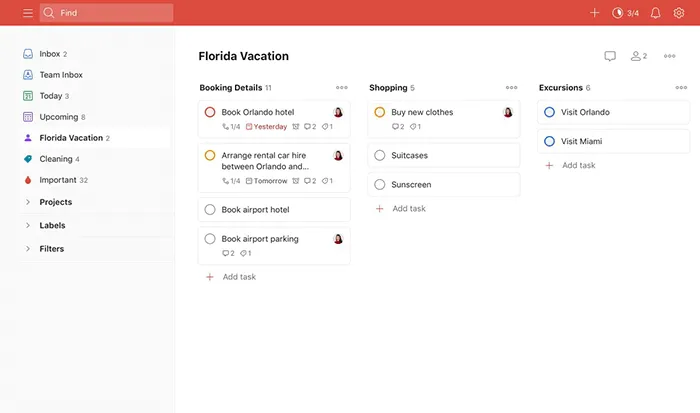
While both Todoist and Notion can be used for task management, Todoist offers a simpler, more streamlined experience. It has a straightforward interface that is easy to use, and it offers a range of features to help you stay organized and on top of your tasks.
You can use Todoist to create tasks, assign due dates and priorities, and organize them into projects and subtasks. It also provides various productivity features, such as recurring tasks, reminders, labels, and filters.
Focused solely on task management, Todoist requires minimal customization or setup. It can be an excellent solution for small teams and individuals who do not require the more extensive range of features offered by Notion, such as creating notes, wikis, and databases.
Why you might prefer Todoist over Notion:
- Todoist is fully optimized for task management and doesn't try to do too many things at once.
- Todoist is easier to get started with, the initial setup requires minimal configuration.
- Todoist offers fewer features and options, allowing it to keep its interface clean and clutter-free.
What users say about Todoist:
"Even though Notion is a great software, with so many tools and uses, Todoist is a way better platform for task management and productivity. Notion was very limited for this use and I felt like it wasn't as easy to create and manage my tasks, as it is in Todoist. I'm very happy I made the switch."
Looking for more tools similar to Todoist? Check out this list of Todoist alternatives.
Other alternatives
It's worth noting that your options are not limited to just Notion and Todoist. There are plenty of other fantastic productivity tools that can be just as effective, if not better. For example, if you're drawn to the idea of consolidating multiple tools into a single solution like Notion, but prefer the simplicity of Todoist, consider Nuclino.
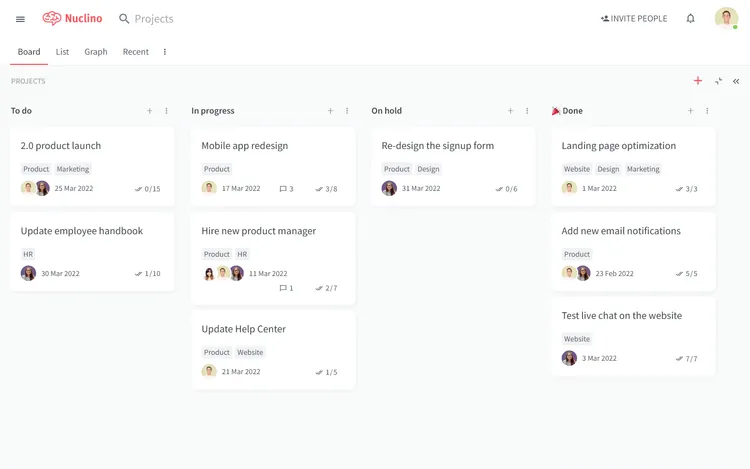
Like Notion, Nuclino is a versatile collaboration tool that allows you to bring all your knowledge, docs, and projects together. You can visually organize your work in a nested list, a Kanban board, a table, or a mindmap-style graph. It can be a great solution for a wide range of use cases, including sprint planning, document collaboration, project management, and more.
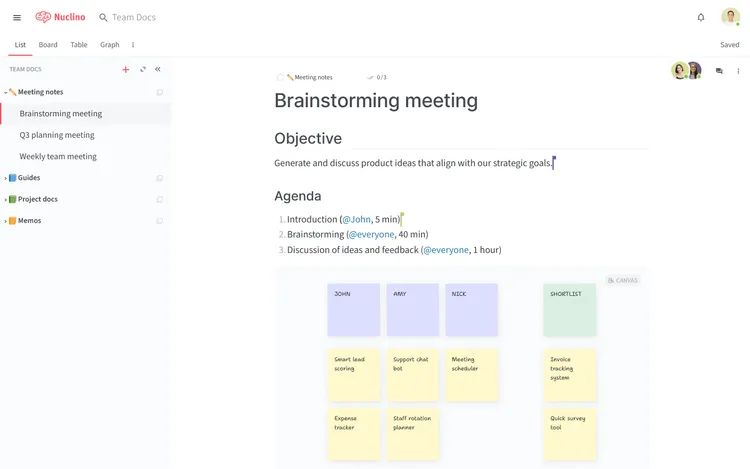
At the same time, like Todoist, Nuclino is simple and intuitive. It focuses on the essentials and offers a clean, distraction-free interface with no clunky menus and rarely-used options.
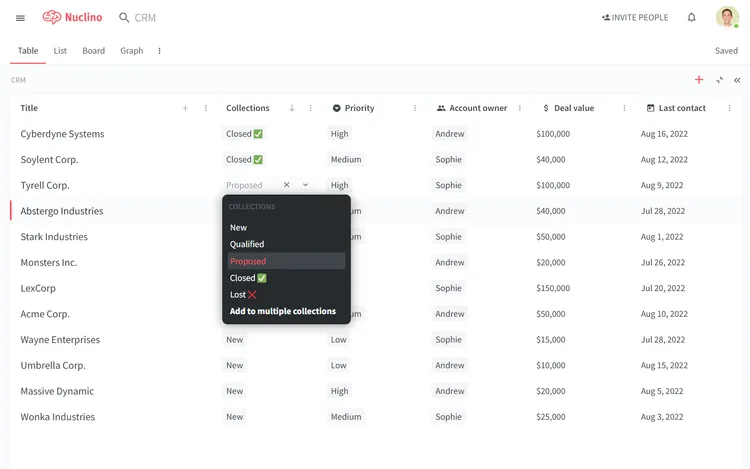
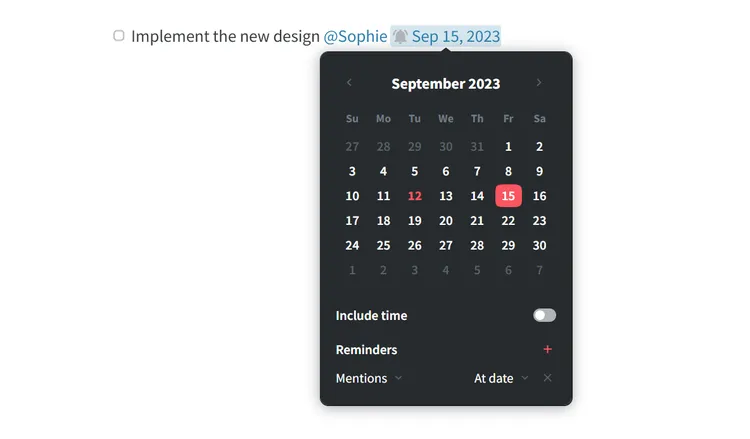
Every card that you add to your Nuclino board is a collaborative document. This helps you to maintain context as you work, allowing you to document the goals and decisions relevant to each task, create to-do lists with due dates and reminders, and embed files, among other things.
You can also exchange asynchronous feedback directly in Nuclino using comments and mentions.

Learn more about how Nuclino compares to Notion: Nuclino vs Notion.
Notion vs Todoist: So which is better?
While both Todoist and Notion offer task management functionality, the key difference between them is the scope of their capabilities. Todoist is a simple and efficient tool for managing personal to-do lists, while Notion is a more comprehensive workspace that allows users to organize information, manage projects, collaborate with others, and create custom workflows.
On the other hand, if you want the best of both worlds and value both simplicity and flexibility, consider exploring other alternatives, such as Nuclino.
We hope this article has made your decision a little easier and recommend you take all three tools for a spin.