Notion can do a lot in one workspace. Teams use it for docs, projects, databases, meeting notes, and internal tools, and it is also popular for personal notes and knowledge. Replacing it can mean anything from finding a faster notes app to moving an entire company wiki or project system.
Some of the tools in this guide cover a similar range. Others focus on one part of the Notion experience, with deeper project management, stronger database features, local files, or self-hosting.
We considered more than 100 tools similar to Notion before narrowing the list down to these 11. We tested the finalists ourselves, looking at how each one feels to use, where it improves on Notion, where it gives something up, and what switching involves.
Why look for a Notion alternative?
Notion's flexibility can become harder to manage as a workspace grows. In recent Reddit discussions, users mention slow performance, complex setups that take ongoing maintenance, and wanting a simpler tool for a specific job. Others are looking for local files, better offline access, or more control over where their data is stored. If you'd also prefer a provider based in Europe, see our comparison of the best European alternatives to Notion.
Notion now supports offline pages, but some users still find the offline experience limiting. For others, the issue is more specific: they want deeper project management, better database tools, a more focused knowledge base, or a faster personal notes app.
Best Notion alternatives at a glance
| Tool | Best for | G2 rating | Starting price | Main limitation |
|---|---|---|---|---|
| Nuclino | Team knowledge, docs, projects, and whiteboards | 4.7 | Free; Paid plans from $6/user/month | Less depth for relational databases and automation |
| Obsidian | Personal knowledge and local files | 4.5 | Free; Sync from $4/user/month | Team administration is limited |
| Slite | Maintaining a team knowledge base | 4.6 | $10/user/month | Limited project and database functionality |
| Superhuman Docs | Tables, formulas, and custom workflows | 4.6 | Free; Paid plans available | Takes time to learn |
| Confluence | Jira users and larger organizations | 4.1 | Free; Standard from $5.42/user/month | Workspace administration can get heavy |
| Airtable | Databases, operations, and lightweight CRM | 4.6 | Free; Team from $20/user/month | Long-form documentation is secondary |
| ClickUp | Detailed project and task management | 4.6 | Free; Unlimited from $7/user/month | Large feature set takes time to learn |
| Capacities | Object-based personal knowledge management | No rating | Free; Pro from $9.99/month | No collaborative editing or team spaces |
| Anytype | Private, local-first knowledge management | No rating | Free for personal use | Its object model has a learning curve |
| AFFiNE | Local-first docs, databases, and whiteboards | No rating | Free; Pro from $6.75/month | Smaller ecosystem of integrations and templates |
| AppFlowy | Open-source clients and self-hosting | No rating | Free; Pro from $10/user/month | Some advanced workflows remain less mature |
How we tested these Notion alternatives
We tested each product ourselves and checked current documentation and pricing. We also reviewed feedback on G2, Capterra, and Reddit to see where our experience matched recurring feedback from longer-term users. Ratings and review counts were checked in September 2026.
We compared the tools across six areas:
-
Scope and depth: How broadly the product can cover a Notion workspace, and how much depth it offers in the areas it focuses on (docs, databases, projects, knowledge management, personal notes, and so on).
-
Ease of use: How easy the product is to set up, navigate, and use compared with Notion, including how much configuration it needs before it becomes useful.
-
Organization and flexibility: How well it handles documents, structured information, projects, links, and different ways of organizing a workspace.
-
Collaboration: Real-time editing, sharing, permissions, guest access, and team administration where relevant.
-
Switching from Notion: Import options, export formats, data portability, and how much work is involved in moving an existing workspace.
-
Pricing: Free-plan limits, paid tiers, AI costs, and the price of using the product with a larger team.
Top 11 Notion alternatives
1. Nuclino
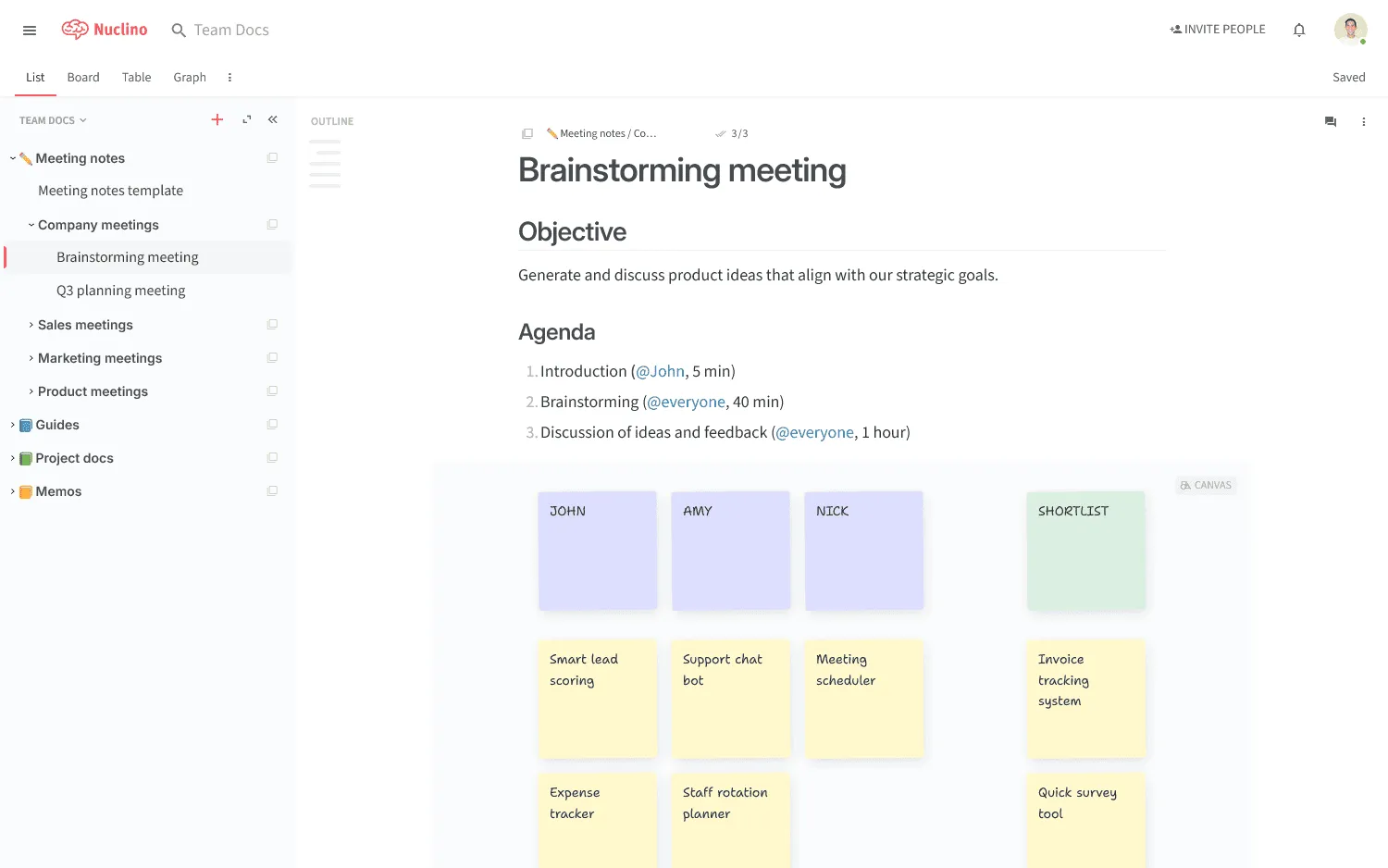
Nuclino brings team documentation, project tracking, internal knowledge, and collaborative whiteboards into one workspace. It has fewer menus and setup options than Notion, and most teams can establish a clear structure without much configuration.
Content lives in one hierarchy and can also appear as a list, board, table, or graph. The same item can work as a document or a project card, so notes, checklists, files, comments, assignees, and dates can stay together instead of being split across separate tools.
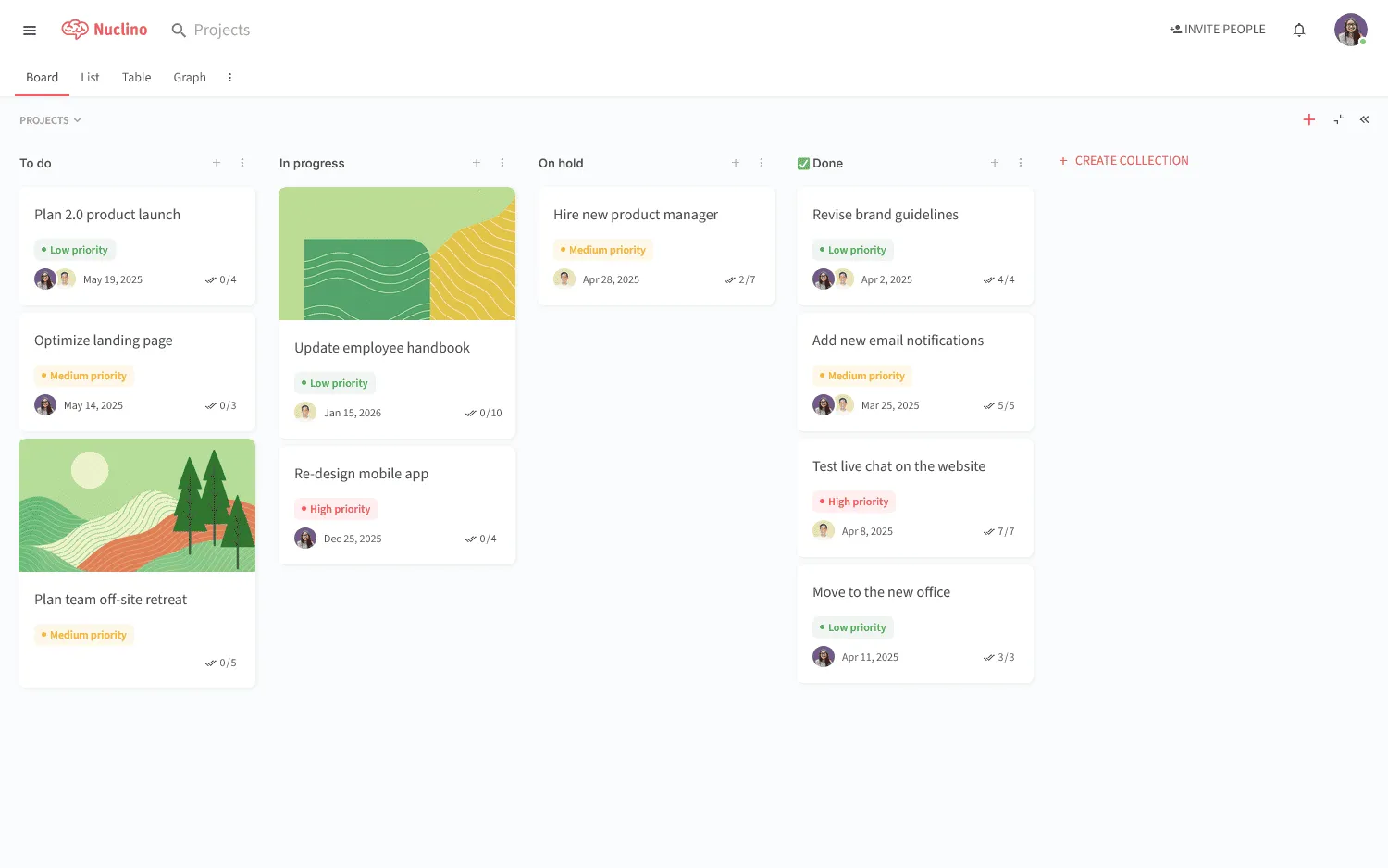
Navigation and editing also feel lighter. Search is quick, pages open fast, and there are fewer menus to work through. Teams that find themselves spending too much time maintaining a complex Notion setup may prefer this simpler model.
Canvas adds collaborative whiteboards for diagrams, brainstorming, and process mapping. AI-powered Sidekick can answer questions, summarize content, and help with writing, and the MCP server lets compatible AI assistants search and update workspace content using the connected user's permissions.
Nuclino is less capable when databases become complex. Notion has more advanced relations, rollups, formulas, and automation, so highly customized database systems are harder to reproduce.
Our Nuclino vs Notion comparison goes deeper into those differences.
Pricing: The free plan includes up to 50 items and three canvases. Paid plans start at $6 per user per month.
2. Obsidian
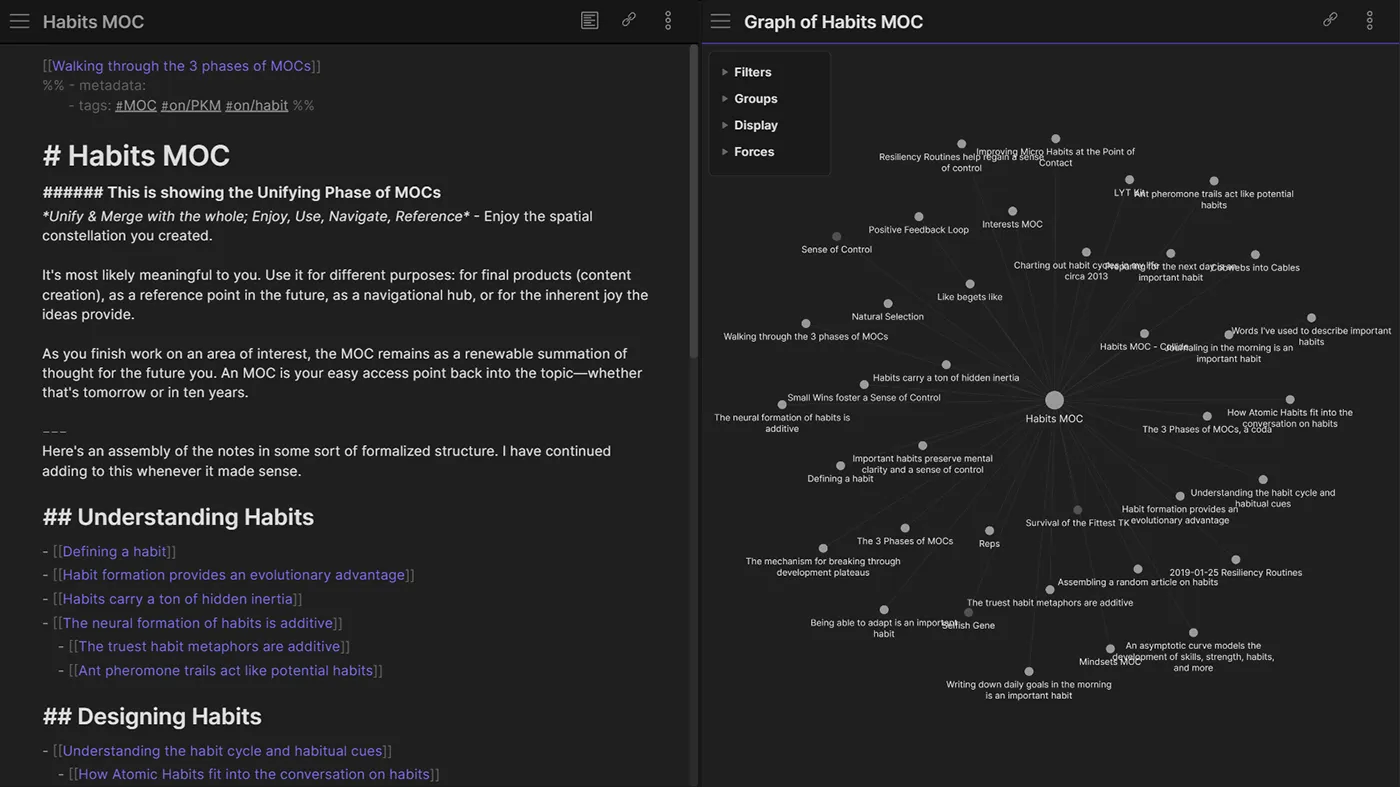
Obsidian is one of the most popular Notion alternatives for personal knowledge management, especially if you want your notes stored locally. Every note is a plain Markdown file on your device, so you can access it outside Obsidian, work offline, and keep direct control over your files.
The app starts out very bare. Its value becomes clearer once you have enough notes for backlinks, properties, and Graph View to become useful. Bases can turn those properties into filtered and sortable views without changing the underlying Markdown files.
A lot of Obsidian's flexibility comes from community plugins. They can add task management, publishing, database features, AI assistants, and many smaller additions. A heavily customized vault can end up depending on quite a few plugins, so there is more to maintain over time.
Obsidian also works well for people who specifically want a Notion alternative without AI. None of its official core plugins includes an AI assistant. You can add one through community plugins, or leave AI out completely.
Team collaboration is much less developed. Obsidian Sync supports shared vaults, but permissions and administration are fairly basic compared with Notion. Our Obsidian vs Notion comparison looks more closely at the differences between the two.
Obsidian has an official Importer plugin for Notion. It can connect directly to your Notion account and convert databases and formulas into Obsidian Bases. You can also import a Notion export file, though that method does not preserve databases.
Capterra users rate Obsidian 4.0/5 for ease of use, noticeably below its 4.8/5 overall rating. That fits our experience: the basic editor is straightforward, but building a more elaborate system takes time.
Pricing: Obsidian itself is free with no usage limit. Sync costs $4 per user per month with annual billing.
3. Slite
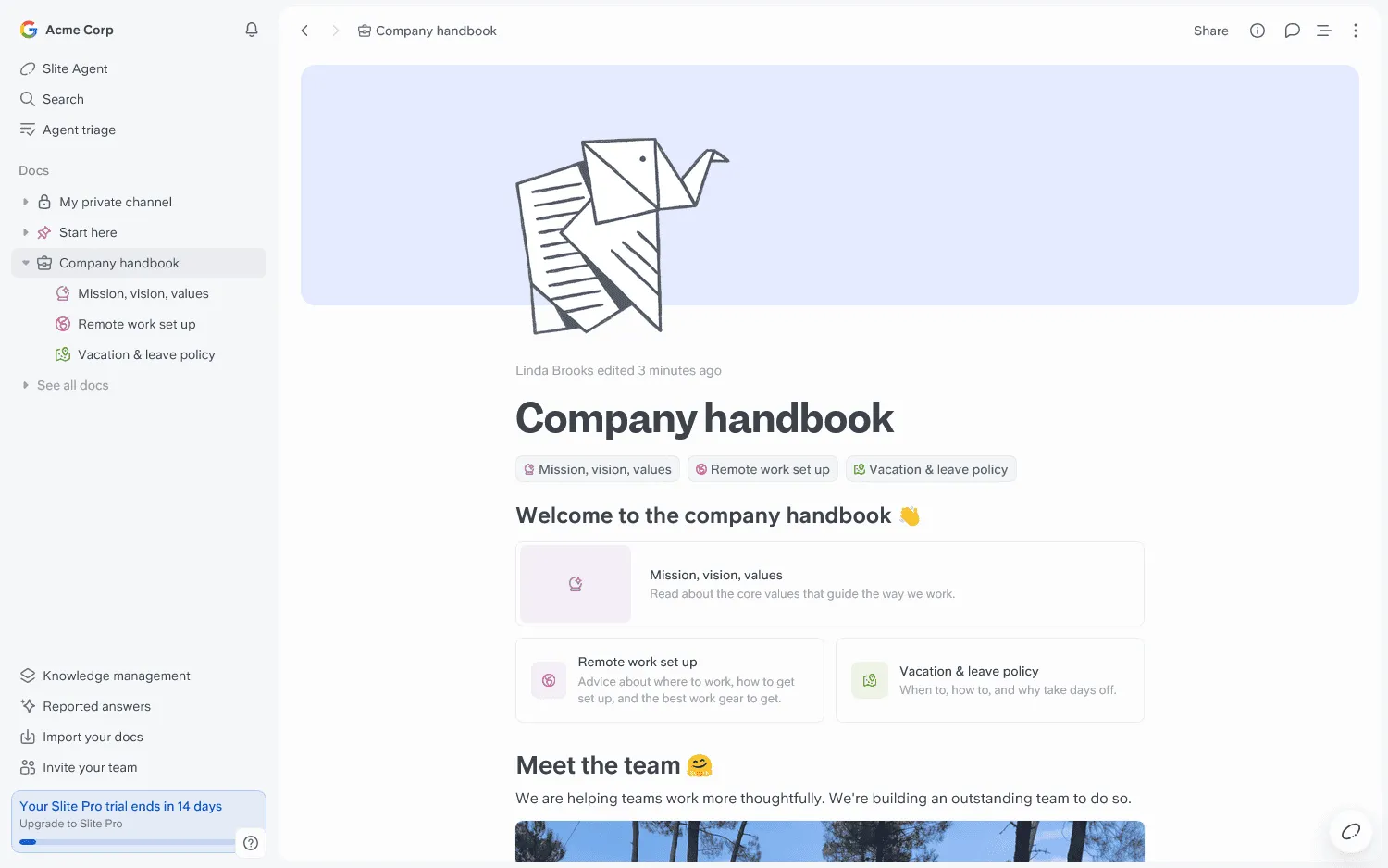
If you use Notion mainly as an internal wiki or knowledge base, Slite is one of the more focused alternatives. It gives up much of Notion's flexibility around databases and project tracking and puts more attention on keeping documentation organized and current.
The review workflow is one of the clearest differences from Notion. Once a document has an owner and review date, you can immediately see who is responsible for keeping it current. That is particularly useful for policies, processes, and other documentation that needs regular attention.
AI is closely tied to the same workflow. Ask searches the workspace and answers questions using existing content. The Pro plan adds Slite Agent, connected search across other workplace tools, and suggestions when information appears to be outdated.
Slite starts to feel restrictive once you move beyond knowledge management. Custom databases, complex project systems, and operational workflows are much more limited than in Notion. Teams using Notion mainly as a wiki may not miss that flexibility, but teams running projects and structured workflows probably will. We explore those differences further in our Slite vs Notion comparison.
Slite has a dedicated Notion importer. You can move individual pages or an entire workspace, including the page structure, links, images, videos, and databases. Notion databases are converted into Slite Collections, though users and mentions do not carry over.
Pricing: Basic costs $10 per user per month with annual billing. Pro costs $20.
4. Superhuman Docs (formerly Coda)
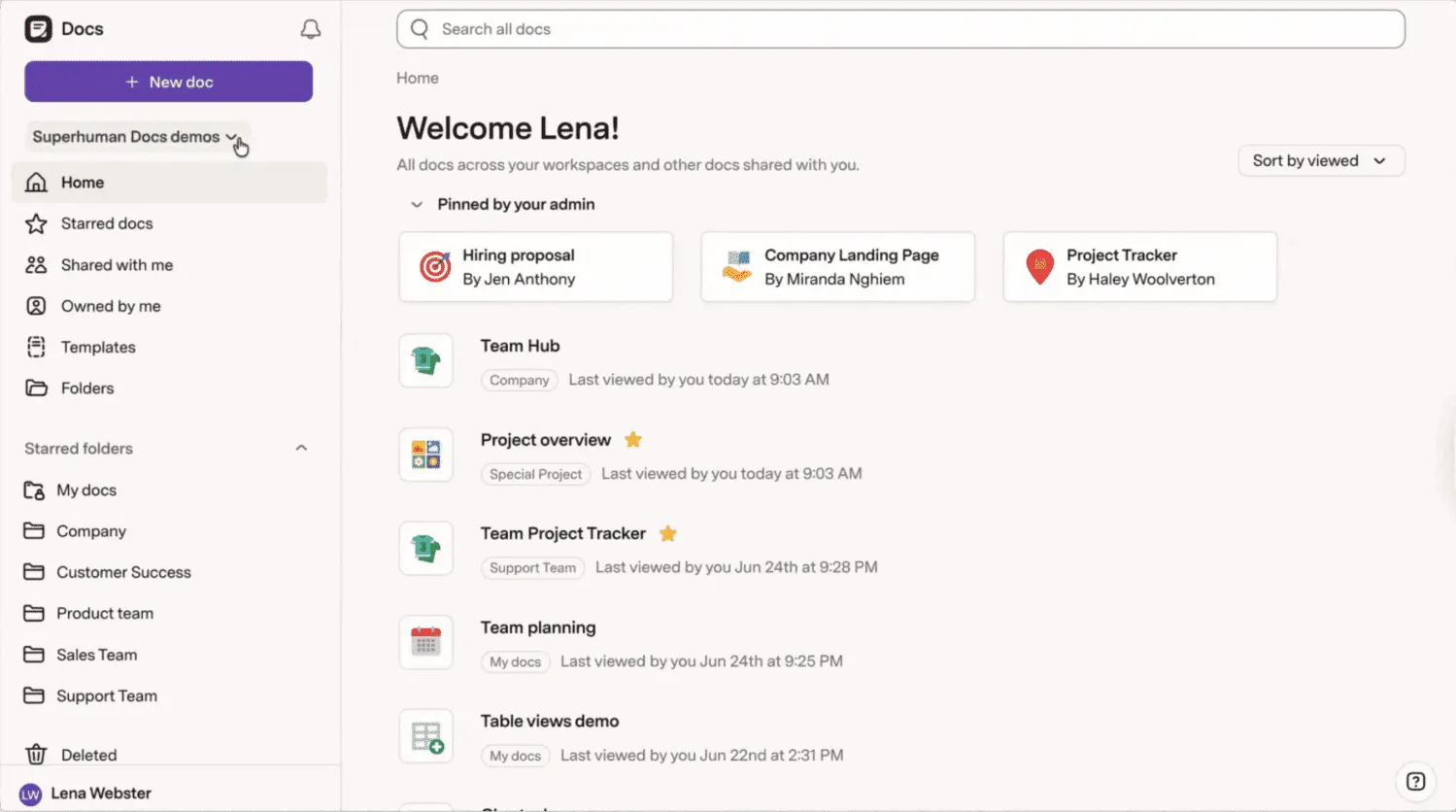
Superhuman Docs, formerly Coda, gets interesting once a document starts turning into a small internal system.
We started with a basic tracker and added formulas, buttons, and connected tables. It quickly became closer to an internal app than a normal document. This is where it goes further than many Notion setups: formulas and controls can drive fairly complex workflows directly inside the doc.
Packs bring data and actions from external services into Docs, and automations can handle recurring steps. Docs AI can work with text and structured data, and MCP support adds more ways to connect external AI tools.
Complex Docs can take time to learn. Once formulas, controls, automations, Packs, and several connected tables are involved, a new user has a lot to understand.
If database-heavy workflows are the reason you're considering it, our Coda vs Notion comparison goes deeper into that part of the two products.
Pricing: Superhuman Docs has a free tier. Paid Docs subscriptions use Maker billing, so only Doc Makers require paid seats. Editors and viewers do not. That can make a noticeable difference for a team where a smaller group builds the workflows and many more people mainly use or contribute to them.
5. Confluence
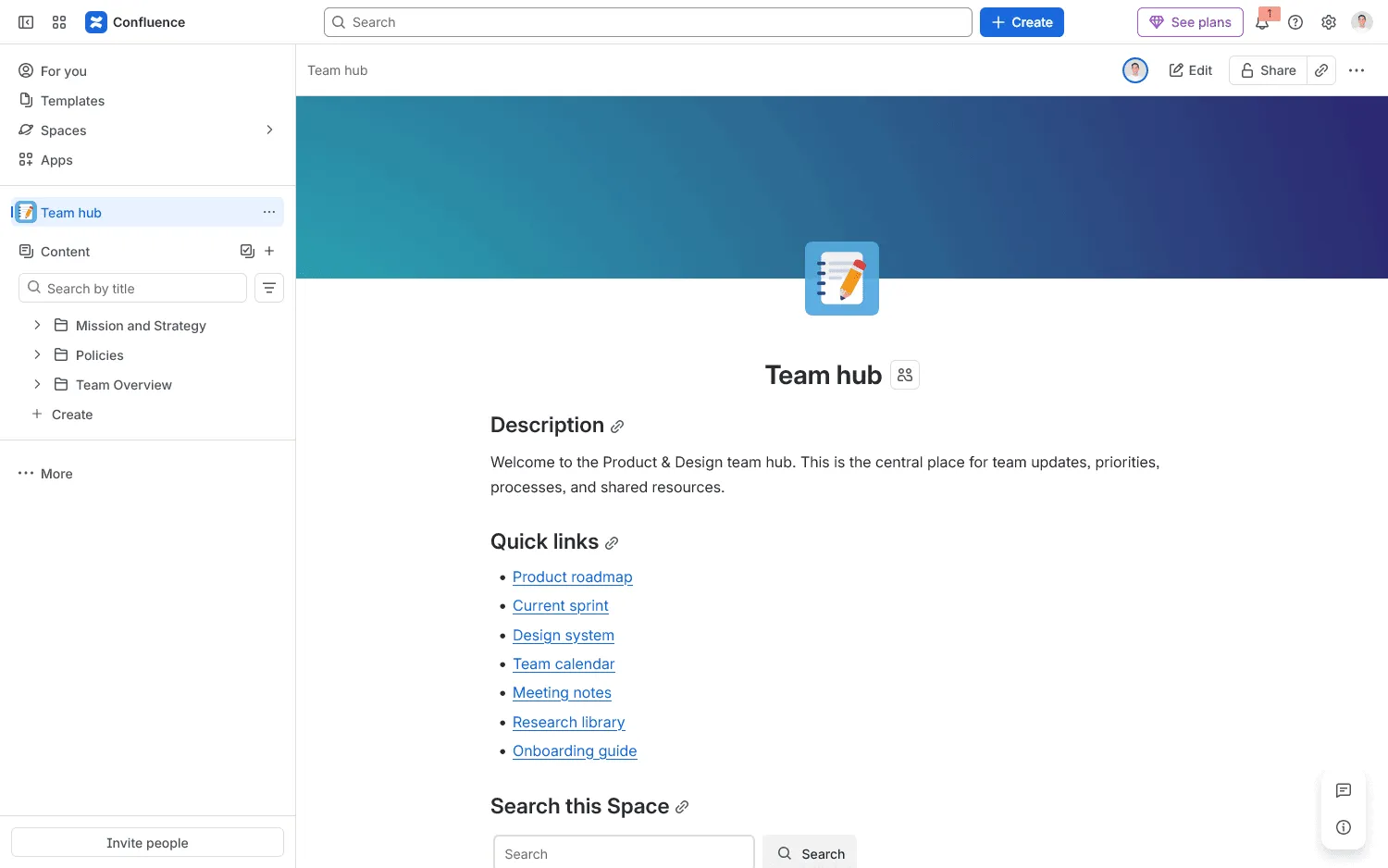
For teams already using Jira, Confluence has an obvious advantage: documentation can sit close to the engineering and product work it refers to.
Product specs, technical notes, project documentation, and decisions can all connect back to work in Jira. That makes Confluence particularly relevant for teams considering a move from Notion into the wider Atlassian ecosystem.
The workspace itself feels more structured than Notion. Content is organized into spaces and page hierarchies, with detailed permissions for users and groups. Guests can be invited without taking a paid seat on Standard, and selected pages can be shared publicly.
Confluence also includes whiteboards, databases, automation, and Rovo for AI-powered search, chat, and agents.
Confluence requires more administration than Notion. Large collections of spaces and pages can become difficult to navigate, and smaller teams may find the setup heavier than they need. Our Confluence vs Notion comparison covers the difference in more detail.
Confluence has one of the more extensive Notion migration tools in this list. You can import an entire workspace or selected pages with their subpages. The importer can also map users, comments, mentions, permissions, and other workspace information, though some complex content may look different after the move.
Capterra users give Confluence 4.3/5 for ease of use, below its 4.5/5 overall rating. Recent reviews also mention navigation, permissions, and keeping larger collections of pages organized.
Pricing: Confluence has a free plan. Standard costs $5.42 per user per month.
6. Airtable
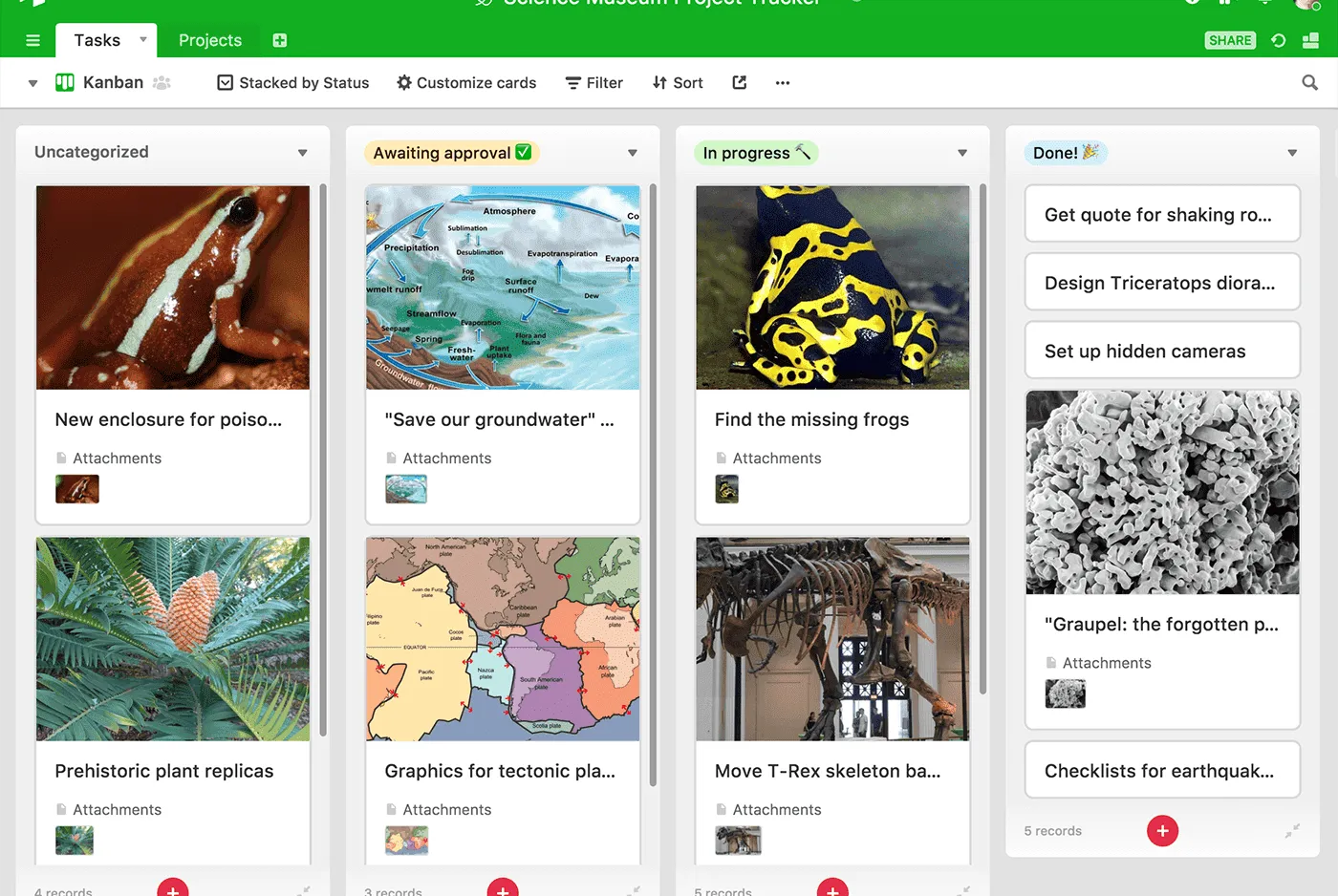
Airtable is a natural step up when the database part of Notion is doing most of the work. Records support linked fields, formulas, attachments, collaborators, and a wide range of field types.
Once several tables start relating to each other, Airtable's data model is easier to inspect and manage than a large Notion setup. Interfaces can give different people a simpler way to work with the same data without exposing the full base.
Forms and automations add more depth for operational workflows. Airtable is particularly well suited to things like CRM pipelines, content operations, recruiting, and asset tracking.
AI features can classify records, extract information, generate text, and run steps inside automations. Airtable is less comfortable for long-form documentation. A large handbook or research library still fits more naturally in a document-first workspace. Our Airtable vs Notion comparison goes deeper into the differences.
Pricing: Team costs $20 per user per month with annual billing. Business costs $45.
7. ClickUp
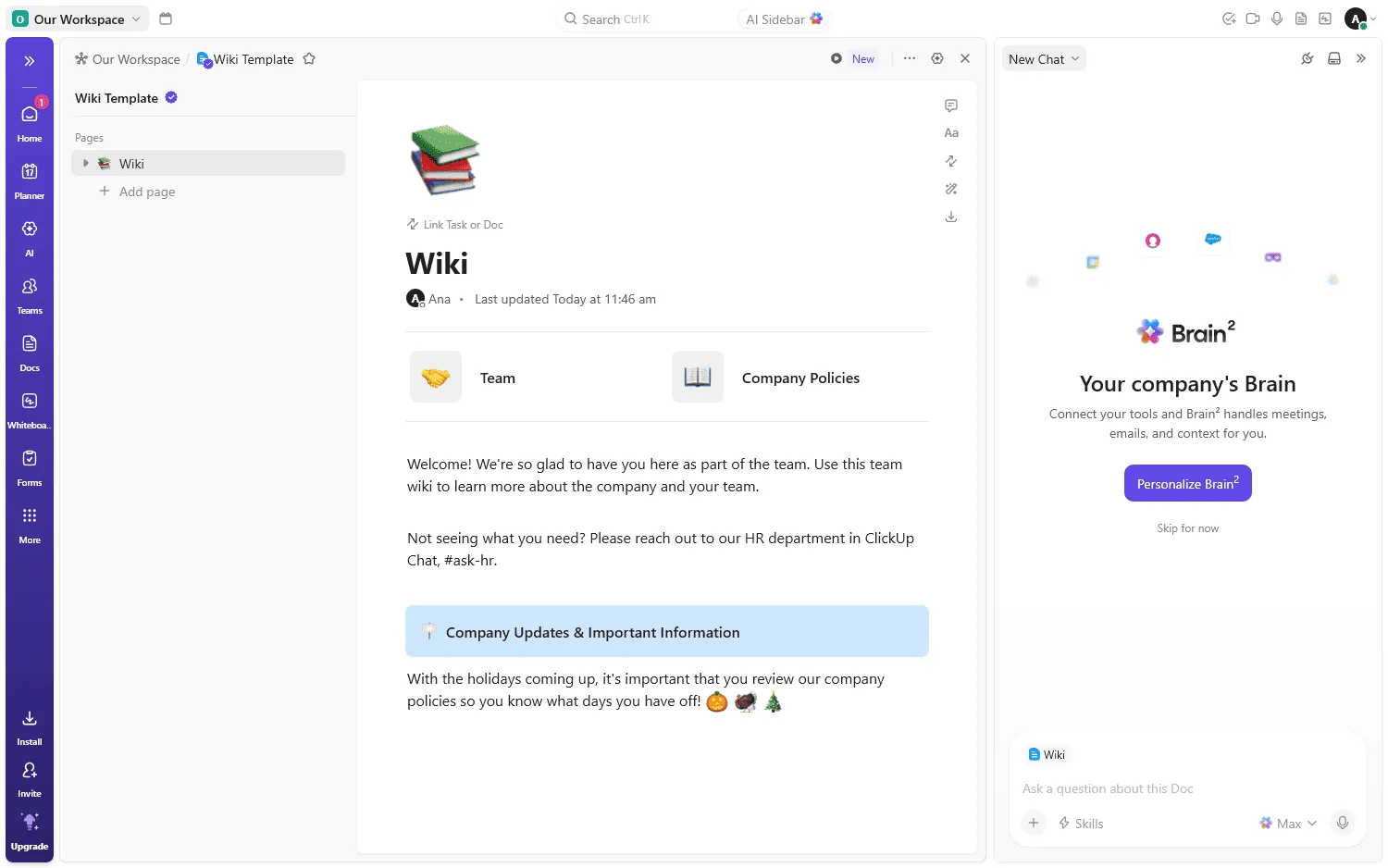
If project management is the part of Notion you have outgrown, ClickUp offers much more built-in structure. Tasks already support subtasks, dependencies, recurring schedules, time tracking, custom fields, and detailed status workflows, so there is less to build yourself with databases and properties.
A basic project was quick to set up in our test. The interface became noticeably busier once we added dependencies, custom fields, and dashboards. ClickUp gives you a lot of ways to view the same work, including boards, calendars, Gantt charts, workload views, and tables, so the amount of configuration can grow quickly.
Much of the interface complexity comes from the project controls built directly into tasks. Dependencies can flag blocked work, recurring tasks are native, time can be tracked directly on tasks, and Custom Fields can feed into Dashboards and reports. In Notion, similar setups usually need more configuration around databases and properties. ClickUp gives project teams more structure from the start, but there is also more of it to learn.
Docs and Whiteboards give projects somewhere to keep briefs, meeting notes, and supporting material. ClickUp Brain adds AI across tasks and documents.
ClickUp fits teams that have outgrown Notion as a project tracker. If the problem with Notion is that the workspace already feels busy, ClickUp is unlikely to feel simpler. Our ClickUp vs Notion comparison goes further into that distinction.
Capterra users rate ClickUp 4.3/5 for ease of use, compared with 4.6/5 overall. That lines up with what we found as the project grew and more fields, dependencies, dashboards, and views were added.
Pricing: ClickUp has a Free Forever plan. Unlimited starts at $7 per user per month with annual billing. Business starts at $12.
8. Capacities
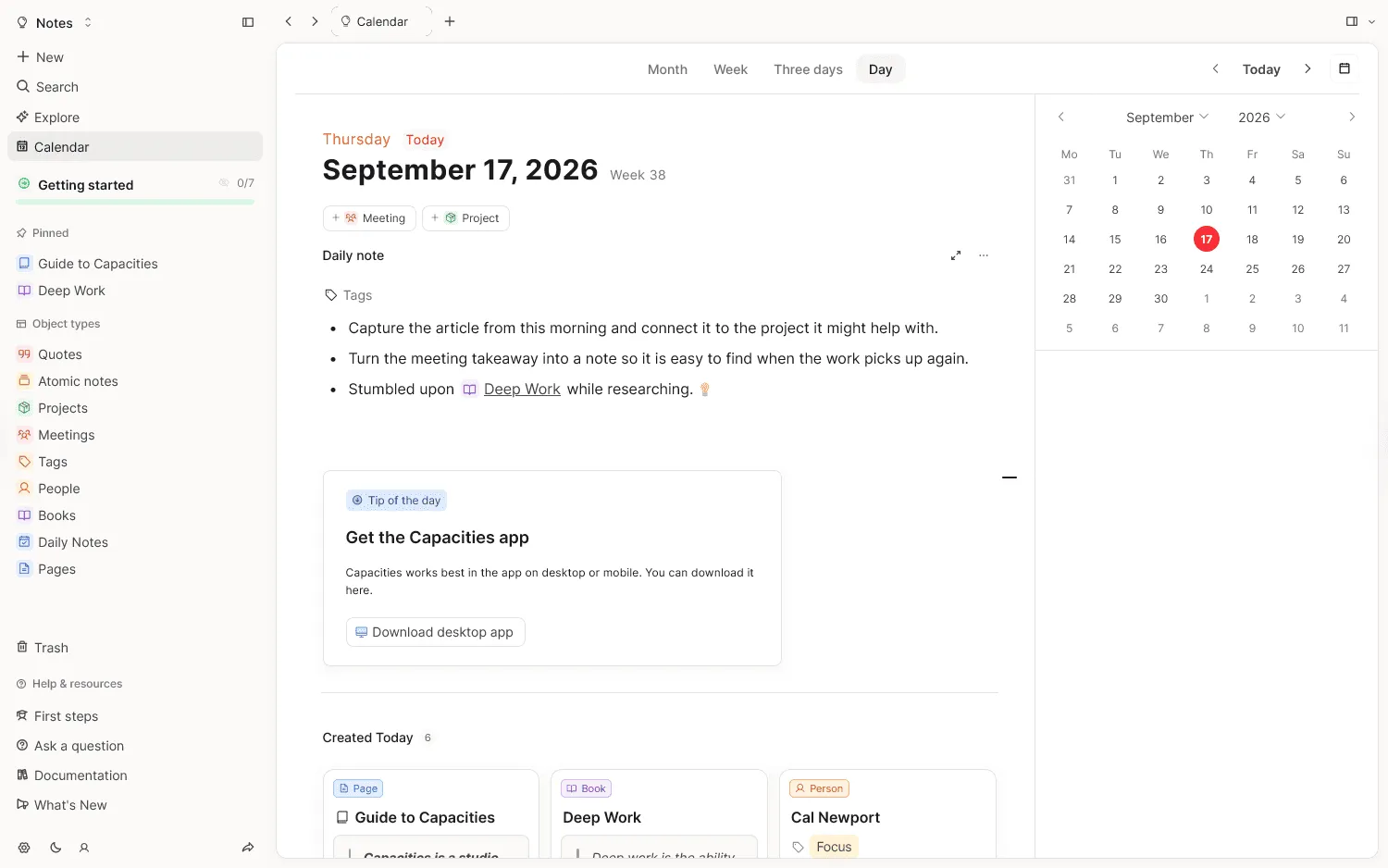
Capacities takes a different approach to personal knowledge management. Instead of organizing everything around pages and nested databases, every piece of content is an object with a type, such as a person, meeting, book, project, or custom category.
That structure becomes useful when the same kinds of information keep appearing across your Notion workspace. Object types can have their own properties and templates, while links and backlinks connect related notes. Daily notes and a built-in calendar provide another way to capture and revisit information over time.
Capacities is also offline-first, so notes remain available without a connection and sync again when you are online. Pro adds features such as AI, smart queries, version history, and calendar integrations.
Collaboration is the biggest limitation for anyone moving from a shared Notion workspace. Capacities is intentionally built for individuals: you can share individual objects for others to view, but there are no team spaces or collaborative editing.
The Notion migration process also requires some restructuring. Capacities recommends exporting Notion content as Markdown and CSV, then mapping it to object types during import. It is not a one-click recreation of a Notion workspace.
Pricing: Capacities Basic is free. Pro costs $9.99 per month.
9. Anytype
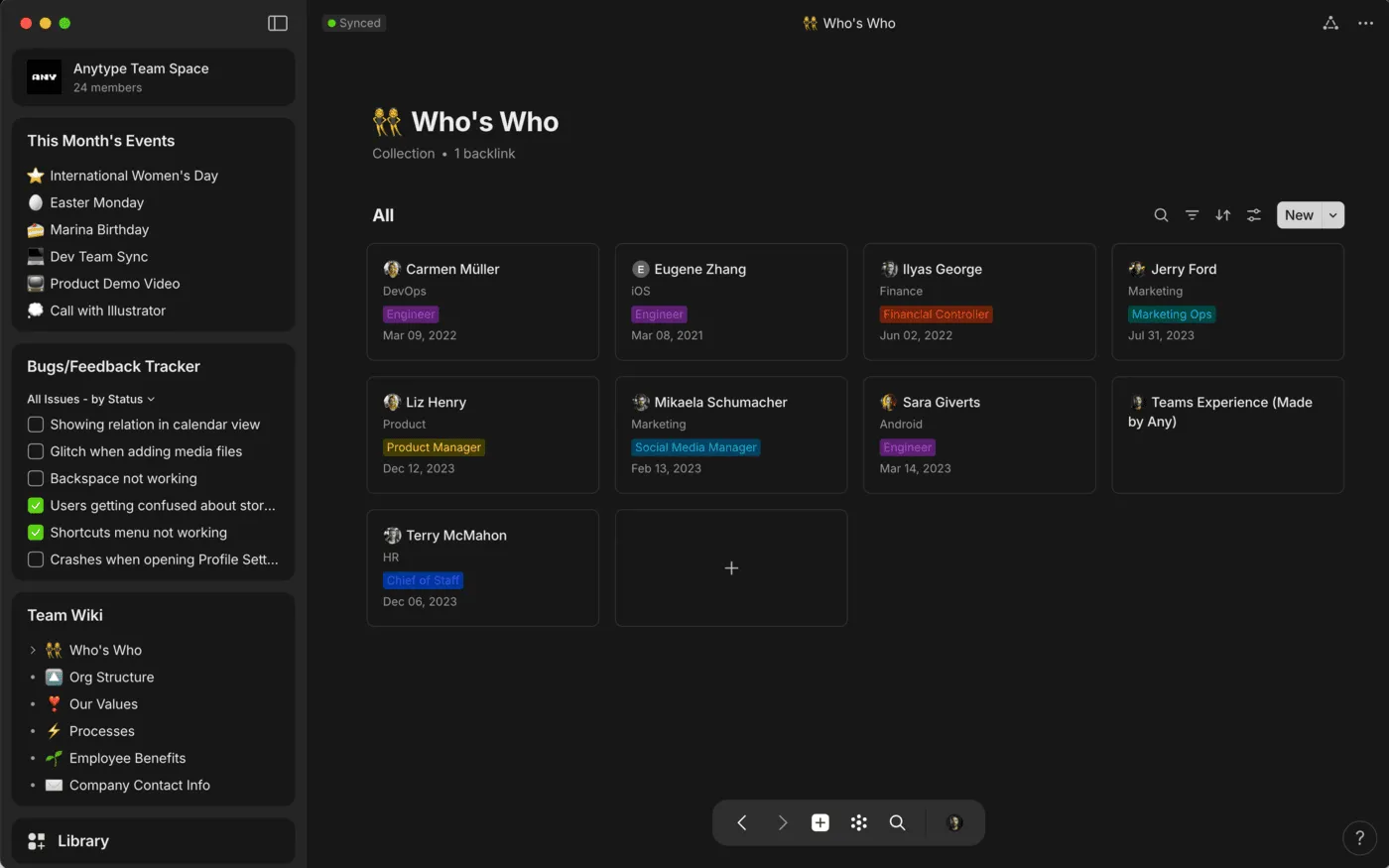
Anytype is a local-first workspace built around objects and relationships. Notes, projects, tasks, people, and other information can each have their own type and properties. If you're used to organizing everything around Notion pages and databases, this takes some adjustment.
A project can connect to its people, meetings, research, and tasks, and those same objects can appear elsewhere without being recreated. Collections and queries give you different ways to work with the same underlying information.
Data storage is another clear departure from Notion. Anytype keeps primary personal data on your devices, supports offline use, and uses encryption and peer-to-peer synchronization.
Desktop apps are available for Windows, macOS, and Linux, along with mobile apps. Anytype also has a separate Business product with central administration for teams.
Pricing: Personal use can remain free with local resources. Anytype Business costs €20 per editor per month. A self-hosted Business edition has been announced but is not yet available.
10. AFFiNE
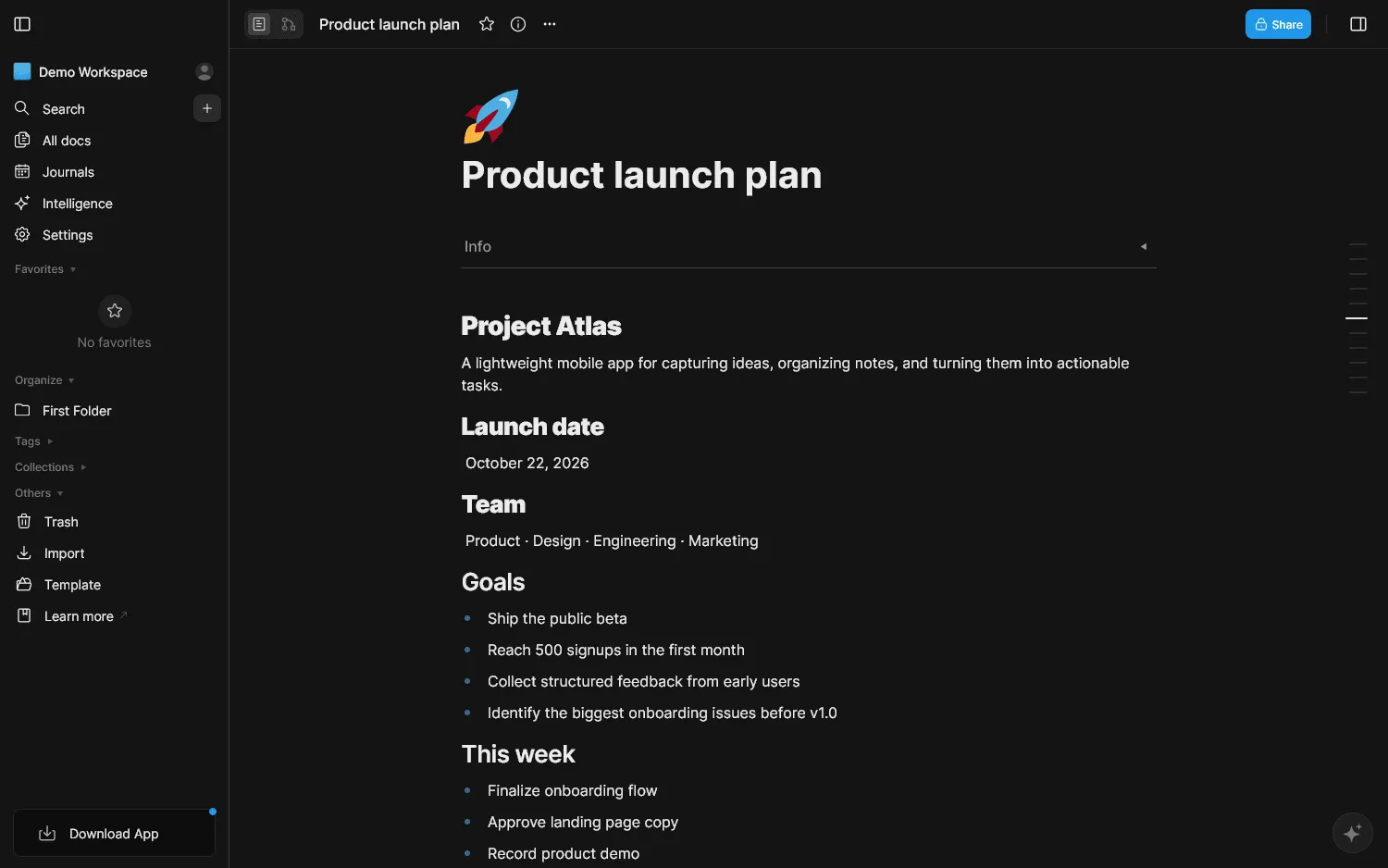
AFFiNE is a local-first workspace that combines documents, databases, and an infinite whiteboard. It covers much of the same territory as Notion but puts more emphasis on offline work, visual thinking, and control over where the workspace runs.
Docs and Edgeless whiteboards live in the same workspace, so written notes, structured information, diagrams, and freeform planning can stay close together. Database blocks add structured views, and AFFiNE AI can work across documents and whiteboards.
The local-first architecture is the bigger distinction. AFFiNE can be used locally, synced through AFFiNE Cloud, or self-hosted. Its editor and most of the codebase are MIT-licensed, while the backend uses AFFiNE's separate Enterprise Edition license.
AFFiNE now includes a Notion importer. Its current migration guide supports exporting a Notion workspace as HTML and importing that content into AFFiNE. The product is still younger than Notion, with a smaller ecosystem of integrations, templates, and third-party resources.
Pricing: AFFiNE has a free plan. Pro costs $6.75 per month with annual billing, and Team costs $10 per seat per month annually.
11. AppFlowy
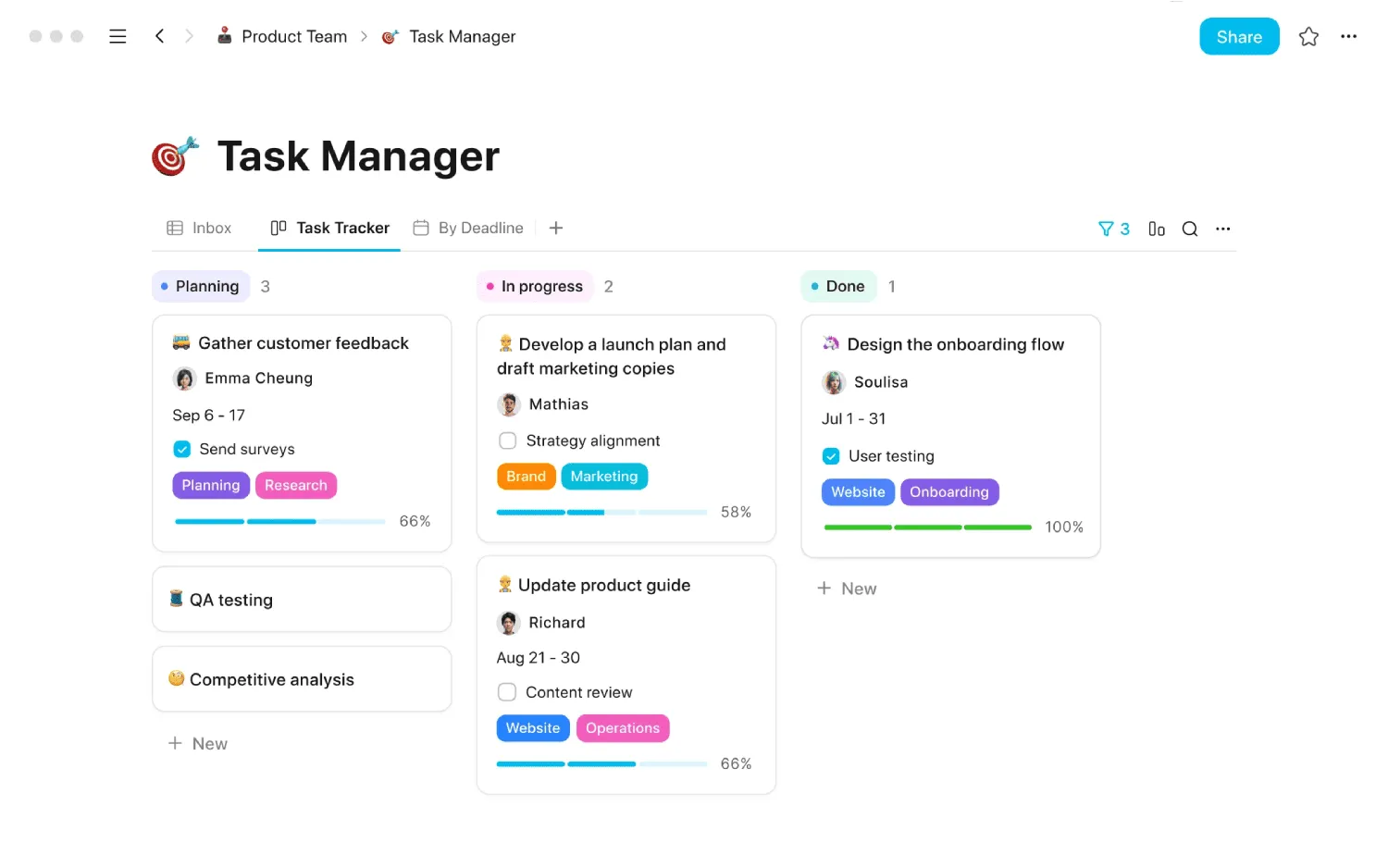
AppFlowy feels familiar quite quickly if you already use Notion. Documents, databases, and project views follow a similar general model, and desktop apps are available for Windows, macOS, and Linux.
AppFlowy gives you more control over where the workspace and AI run. A Vault Workspace can stay private and offline on your device, and AI can run locally through Ollama. AppFlowy Cloud adds shared editing for teams that want collaboration.
The main client is published under AGPLv3. Self-hosting is available, though the actively maintained production backend used for cloud deployments has a separate commercial self-hosting license.
Notion has a larger ecosystem for integrations, advanced databases, and automation. AppFlowy is a better fit for people who care more about local control, open-source software, or self-hosting.
AppFlowy can import a Notion workspace from its exported ZIP file, including pages and databases. The import creates a new AppFlowy workspace for the migrated content. AppFlowy also offers migration assistance for larger organizations moving from Notion.
Pricing: AppFlowy Cloud has a free tier. Pro costs $10 per user per month with annual billing. Vault Workspace costs $6 per user per month annually.
How to choose a Notion alternative
Start with the part of your current setup that matters most. A company wiki, personal research system, CRM, and project portfolio put very different demands on the software.
| Your priority | Tools to look at |
|---|---|
| Shared knowledge, docs, projects, and whiteboards | Nuclino |
| Personal notes stored locally | Obsidian, Anytype |
| A maintained company knowledge base | Slite, Nuclino |
| Complex tables, formulas, and workflows | Superhuman Docs, Airtable |
| Jira-connected documentation | Confluence |
| Detailed project and task management | ClickUp |
| Object-based personal knowledge management | Capacities, Anytype |
| Local-first privacy | Anytype, Obsidian, AFFiNE |
| Open-source software and self-hosting | AFFiNE, AppFlowy |
| No built-in AI assistant | Obsidian |
FAQ
What are the best free alternatives to Notion?
Obsidian is a good free option for personal knowledge management, with no usage limits on the core app and notes stored locally. For collaborative work, Nuclino and ClickUp both offer free plans. Airtable, Capacities, AFFiNE, AppFlowy, and Superhuman Docs also have free tiers, though the limits vary considerably.
What are the best open-source and self-hosted Notion alternatives?
AFFiNE combines local-first documents, databases, and whiteboards, with an MIT-licensed editor and support for self-hosting; its backend uses a separate source-available Enterprise Edition license. AppFlowy also has an open-source client that can run locally, while its production backend uses a separate commercial self-hosting license. Anytype is local-first and has announced a self-hosted Business edition.
Which Notion alternatives work offline?
Offline use is built into Obsidian, Anytype, Capacities, and AFFiNE. Obsidian keeps Markdown files directly on your device, Anytype and AFFiNE use local-first architectures, and Capacities keeps notes available offline and syncs changes when you reconnect. AppFlowy can run locally as well. Notion now supports offline pages, so the bigger distinction is where your data lives and how dependent the app is on its cloud service.
Is there a Notion alternative without built-in AI?
Yes. Obsidian does not include an AI assistant in its core app. You can use it without AI at all, or add AI later through community plugins if you want it.
What are the main alternatives to Notion AI?
The options differ quite a bit in what their AI is designed to do. Nuclino uses Sidekick for workspace questions, summaries, and writing, with MCP support for compatible external AI tools. Slite focuses more on company search and keeping knowledge current. Superhuman Docs can work with documents and structured data, and ClickUp brings AI into tasks and project workflows. Our Notion AI alternatives guide compares them in more detail.
Does Microsoft have a Notion alternative?
Microsoft Loop is the closest Microsoft product. It provides shared workspaces, pages, and portable Loop components that stay synchronized across Microsoft apps such as Teams, Outlook, OneNote, and Whiteboard. Loop is particularly relevant for organizations already working inside Microsoft 365. See our Microsoft Loop vs Notion comparison for more detail.
Does Google have a Notion alternative?
Google does not currently have one product that maps directly to Notion. Google Workspace spreads similar capabilities across Docs, Sheets, Drive, Calendar, Meet, and Gemini. Teams already committed to Google's ecosystem may prefer that setup, but the information remains split across several applications.