Wiki software gives teams and individuals a shared place to create, organize, and maintain knowledge. Some tools focus on internal company documentation, others give you full control over hosting, and a few are designed mainly for personal knowledge.
The main differences are how each tool handles editing, search, permissions, hosting, and maintenance. Your priorities will usually narrow the list quickly.
This guide compares 12 wiki tools across those areas, with a mix of hosted services, self-hosted platforms, open-source software, and personal wikis.
Wiki software comparison
The table below gives you a quick way to compare the main options. Follow the tool links for a closer look at each one.
| Wiki software | Best for | Hosting | Free option |
|---|---|---|---|
| Nuclino | Simple collaborative team wikis | Hosted | Yes |
| Confluence | Large teams using Atlassian tools | Cloud or Data Center | Yes, up to 10 users |
| Notion | Flexible wikis, databases, and projects | Hosted | Yes |
| Slite | Keeping internal documentation current | Hosted | 14-day trial |
| Tettra | Teams that work heavily in Slack | Hosted | 30-day trial |
| Slab | Searching knowledge across several tools | Hosted | Yes, up to 10 users |
| MediaWiki | Large public and community wikis | Self-hosted | Free, open source |
| Wiki.js | Technical teams that want self-hosting | Self-hosted | Free, open source |
| BookStack | Structured self-hosted documentation | Self-hosted | Free, open source |
| XWiki | Customizable enterprise wikis | Cloud or self-hosted | Free community edition |
| DokuWiki | Lightweight self-hosted wikis | Self-hosted | Free, open source |
| TiddlyWiki | Personal knowledge and research | Local or self-hosted | Free, open source |
What is wiki software?
Wiki software lets people create, edit, organize, link, and search a collection of shared information. Most wikis also keep a history of changes so earlier versions can be reviewed or restored.
A typical wiki includes:
- An editor for creating and updating content
- Internal links for connecting related topics
- Search for finding information across the wiki
- Navigation and structure for browsing larger collections
- Version history for tracking changes
- Permissions for controlling access
- Collaboration features such as comments, mentions, or simultaneous editing
The same basic idea can support very different uses. A company may create an internal wiki or company wiki for policies and processes. A community may run a public reference site. An individual can use wiki software to organize personal notes or research.
Hosting also varies. Services such as Nuclino, Notion, and Slab handle the infrastructure for you. MediaWiki, Wiki.js, BookStack, and DokuWiki run on infrastructure you manage yourself.
If access is your main concern, our private wiki guide covers privacy and hosting in more detail. You can also compare dedicated free wiki software.
How we evaluated these wiki platforms
We reviewed over 30 wiki tools before narrowing the list down to the 12 included here. We looked at hosted and self-hosted platforms, open-source tools, company wikis, and personal wiki software.
For each product, we checked its current website, pricing, documentation, and help resources and compared it across the same criteria:
- Editing: How easy it is to create, update, and format content
- Search: Full-text search, filters, AI-powered answers, and search across connected tools
- Organization: Hierarchy, collections, spaces, tags, navigation, and internal links
- Collaboration: Real-time editing, comments, mentions, and version history
- Permissions: Roles, groups, private areas, page-level access, SSO, and other access controls
- Maintenance: Ownership, verification, review reminders, analytics, and stale-content management
- Hosting: Cloud hosting, self-hosting, local use, and the technical work involved
- Integrations: Connections with chat, project management, development, and file storage tools
- Portability: Import, export, backups, and access to your data
- Cost: Free options, entry-level pricing, user limits, and hosting or administration costs
We then shortlisted tools that are actively maintained, cover the core requirements of their intended use case, and offer something meaningfully different from the other products in the list.
12 best wiki software tools in 2026
The tools below serve different kinds of users. The first group focuses mainly on collaborative company knowledge. The later entries cover self-hosted platforms, public wikis, and personal knowledge.
Nuclino
Nuclino is a lightweight collaborative workspace for teams that want to get a wiki running without much configuration. It brings docs, wikis, projects, and collaborative whiteboards together in one place.
Items can link directly to one another, and related content can be organized into workspaces and collections. List, board, table, and graph views give teams several ways to browse the same information.
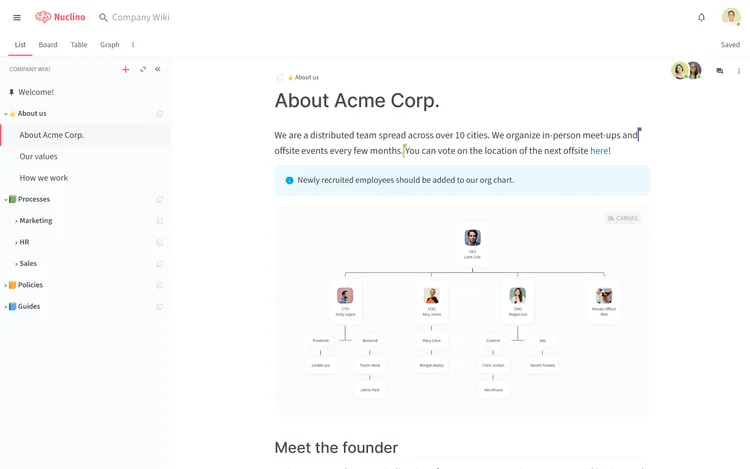
Multiple people can edit an item at the same time, leave comments, mention teammates, and review earlier versions. Search works across the workspace, and Sidekick can answer questions using content the person asking already has permission to access.
Nuclino also keeps the interface relatively simple, so teams do not have to design a complicated system before people can start contributing.
The free plan is useful for trying the product, although it is limited to 50 items. Nuclino is cloud-hosted, so teams that require their wiki to run on their own infrastructure will need a self-hosted tool.
Confluence
Confluence is a mature collaboration platform used for team documentation, project information, and company knowledge.
Content lives in spaces and pages, with templates, databases, whiteboards, version history, and integrations available alongside the core wiki features. Its connection with Jira is particularly useful for product, engineering, and IT teams that already use Atlassian software.
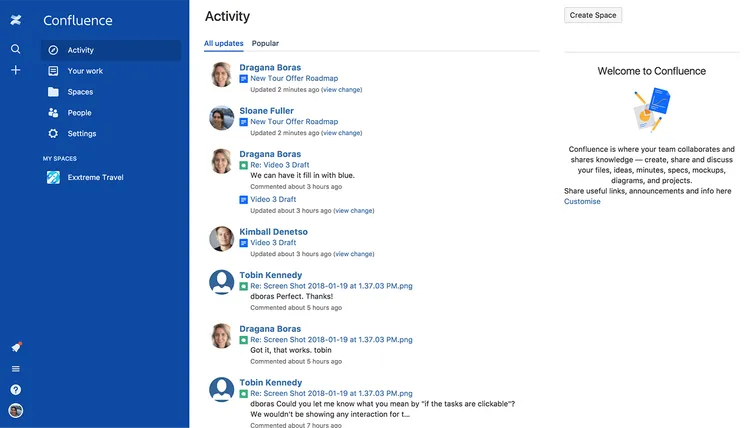
The free cloud plan supports up to 10 users. More detailed permissions, guest access, larger storage limits, and additional administrative features require a paid plan. Organizations that need a self-managed deployment can use Confluence Data Center.
Confluence gives administrators a lot of control, but larger installations can require considerable setup and ongoing management. Spaces, permissions, apps, and templates can accumulate over time if teams do not have clear conventions.
Read our detailed Confluence review or explore the best Confluence alternatives.
Notion
Notion combines documents, wikis, databases, projects, and other structured content in a single workspace.
A regular Notion page can be turned into a wiki. Wiki pages support owners and verification, so teams can show when information has been reviewed and remind owners when it needs attention.
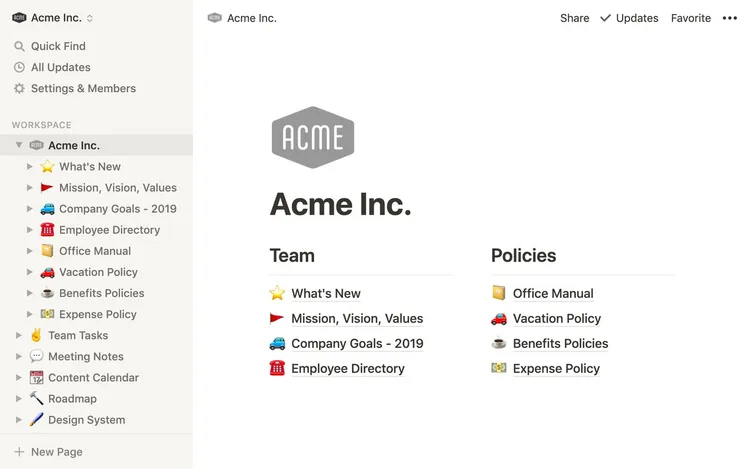
Notion is especially flexible when documentation needs to connect with databases or project information. Teams can create different views, add custom properties, and build their own structure around the way they work.
That flexibility also leaves more organizational decisions to the team. Large workspaces can become difficult to navigate when departments create different page structures and databases without shared conventions.
Notion has a free plan, although some limits become more relevant once several people collaborate in the same workspace.
Our Notion alternatives guide covers other tools with a similar all-in-one approach.
Slite
Slite focuses on internal documentation and the work involved in keeping it current.
Its Basic plan includes unlimited documents, AI-powered search and answers, document verification, and a knowledge management panel. Owners can review important documentation on a schedule and identify information that needs attention.
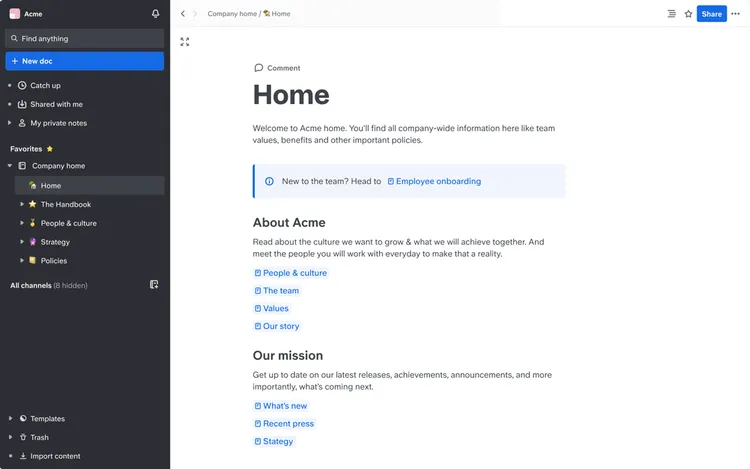
The Pro plan adds Slite Agent, search across connected tools, and suggested fixes when documentation no longer matches information elsewhere. That gives Slite a stronger maintenance focus than many conventional wiki tools.
The product works best for teams that already have a meaningful amount of internal documentation and want a clearer process for reviewing it. Teams looking for a highly customizable workspace or self-hosted deployment will have fewer options.
Slite no longer has a permanent free plan. New workspaces can use a 14-day trial before choosing a paid plan.
See our Slite alternatives guide for other internal wiki tools.
Tettra
Tettra is an internal knowledge base built closely around Slack and recurring team questions.
Its Kai assistant can answer questions using the information stored in Tettra and surface those answers directly inside Slack. Teams can also turn useful answers into reusable knowledge and request new content when something is missing.
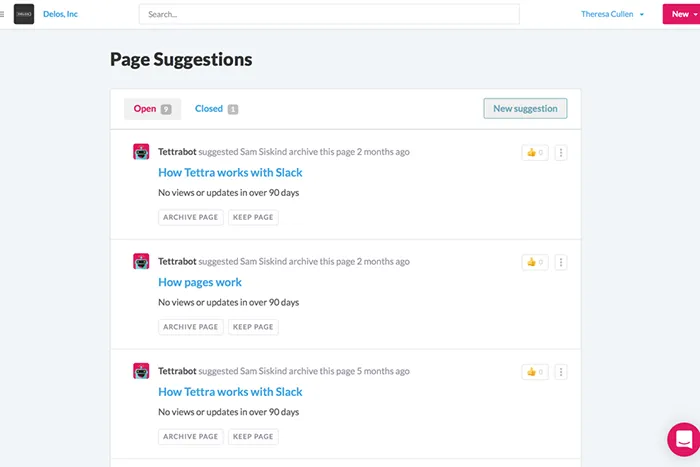
Verification workflows give subject matter experts a way to review important pages on a schedule. Tettra also flags stale, unowned, and public content that may need cleanup.
The Slack integration is a large part of the product, so Tettra is most relevant to teams that already spend much of their day there. Teams using a different communication platform may get less value from that part of the workflow.
Tettra offers a 30-day trial. Its paid Scaling plan has a 10-user minimum.
Looking for a similar tool? See our Tettra alternatives.
Slab
Slab is a dedicated team knowledge base with a relatively simple content model. Information is organized into posts and topics, with real-time editing, templates, verification, and version history.
One of its more useful features is Unified Search. It can surface results from connected services such as Google Drive, Slack, GitHub, Jira, Dropbox, and Confluence alongside information stored directly in Slab.
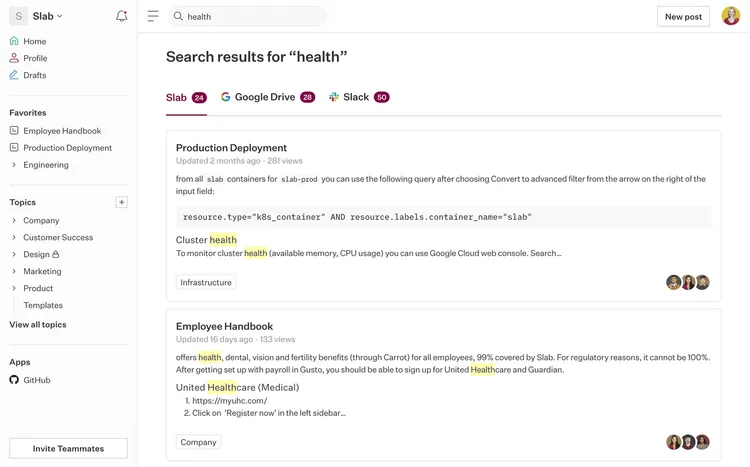
That approach can help teams that cannot realistically move every useful document into one system. Existing information can remain in specialist tools and still appear in wiki searches.
Slab is more focused than an all-in-one workspace such as Notion. It concentrates on company knowledge and integrations, with fewer tools for managing unrelated work.
The free plan supports up to 10 users and includes unlimited posts and topics, real-time collaboration, verification, and Unified Search.
Our Slab alternatives guide covers other tools in the same category.
MediaWiki
MediaWiki is the free, open-source wiki platform that powers Wikipedia and many other large public wikis.
It has a mature system for editing, revisions, internal links, categories, permissions, multilingual content, and extensions. A large ecosystem gives administrators many ways to adapt the platform to a particular project.
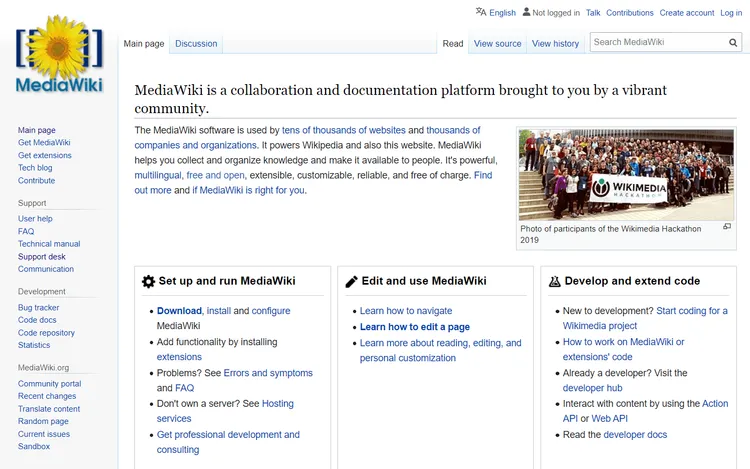
MediaWiki is commonly used for large public and community-driven wikis. Organizations can also restrict access and run it privately.
Installation, upgrades, extensions, hosting, and server security all require technical attention. The editing experience also feels more traditional than newer collaborative document tools.
Teams that want the control of MediaWiki with a different interface or workflow can explore our MediaWiki alternatives.
Wiki.js
Wiki.js is free, open-source wiki software built on Node.js. It runs on your own infrastructure and gives administrators control over authentication, storage, search, appearance, and integrations.
The current stable 2.5 release supports several database systems and works across common server platforms. Pages can be public, private, or use a combination of access rules.
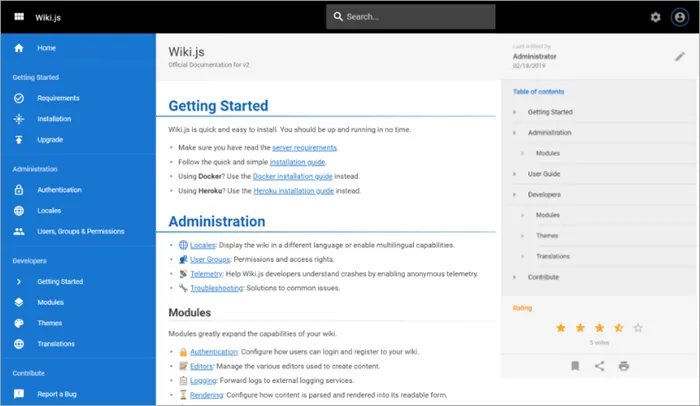
Wiki.js is particularly useful for technical teams that want self-hosting with a cleaner interface than older wiki engines. Markdown support also makes it familiar to many developers.
Wiki.js 3.0 is currently in beta and adds a new architecture along with features such as real-time collaboration. The project still recommends version 2.5 for production installations at the time of this update.
Running Wiki.js means taking responsibility for the server, database, updates, and backups.
BookStack
BookStack is free, open-source wiki software with a deliberately structured approach to organizing information.
Content follows a hierarchy of shelves, books, chapters, and pages. The terminology is easy to understand, and the built-in visual editor means contributors do not need to learn wiki markup.
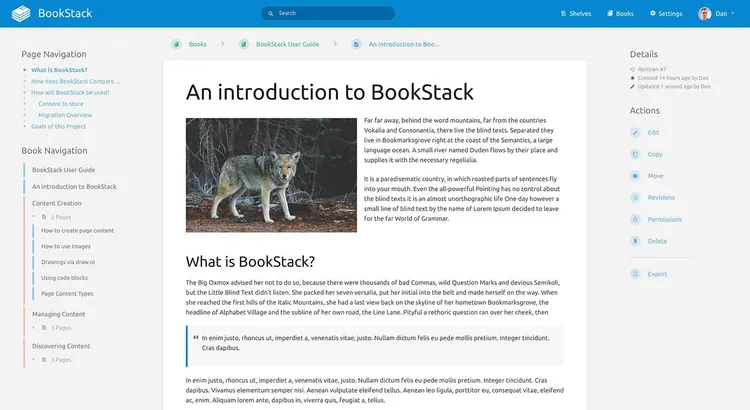
Search works across the whole installation or within an individual book. Users can also link directly to specific sections, and roles and content-level permissions control who can access or modify information.
The fixed hierarchy is useful for manuals, procedures, and documentation that already has a clear structure. Teams that want information to move freely between several organizational models may find it restrictive.
BookStack uses the MIT license and has no software license fee. You still need to host and maintain the installation yourself.
You can also review the best BookStack alternatives.
XWiki
XWiki is an open-source enterprise wiki with considerably more customization than a basic document-based wiki.
Its core features include a WYSIWYG editor, version history, search, imports, attachments, user and group management, and granular access rights. XWiki can also work with structured data, forms, extensions, and custom applications.
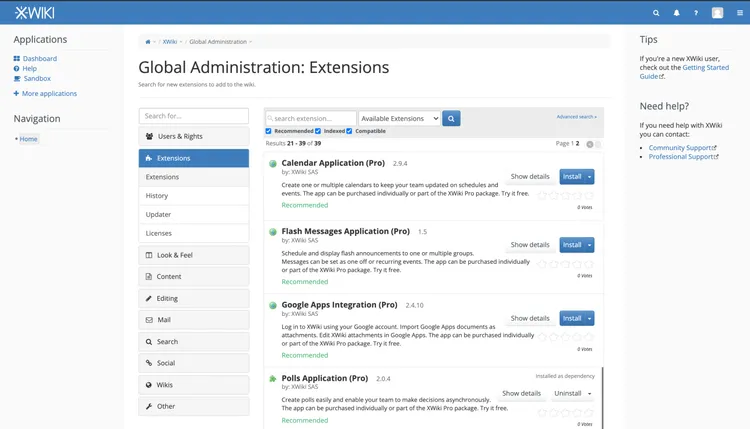
The free Community edition can run on your own infrastructure. XWiki also offers hosted plans and professional support for organizations that do not want to maintain the entire installation themselves.
XWiki makes sense when a company needs a wiki that can be adapted around more complex requirements. That flexibility brings additional administration and a steeper learning curve than simpler team wiki tools.
Organizations comparing wiki software at a larger scale may also find our enterprise wiki guide useful.
DokuWiki
DokuWiki is a lightweight, free, open-source wiki that stores content in plain text files and does not require a database.
That simple architecture has made it popular for smaller self-hosted documentation projects. Files are straightforward to back up, and a large collection of plugins can add functionality beyond the core installation.
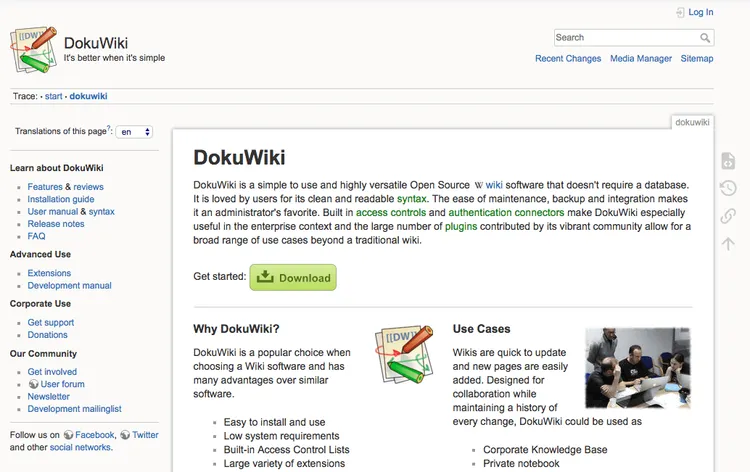
DokuWiki includes access controls and works for both public and private installations. It is well suited to technical notes, internal manuals, small team wikis, and projects where administrators want a relatively small software footprint.
The interface follows a traditional wiki model and can feel dated next to newer document tools. Plugins may also become an important part of the setup when a team needs more advanced functionality.
TiddlyWiki
TiddlyWiki takes a different approach to most of the tools in this list. It is primarily a personal wiki and describes itself as a non-linear personal web notebook.
A complete TiddlyWiki can live inside a single HTML file containing both the application and its content. You can keep the file locally, work offline, put it on a web server, or use a more advanced Node.js setup.
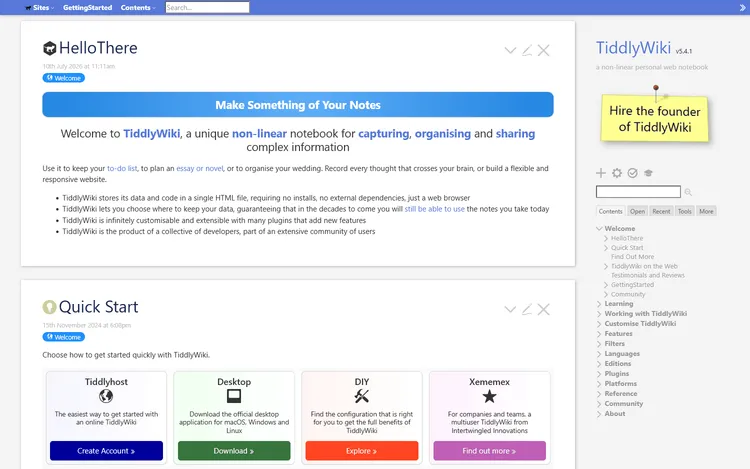
Information is broken into small units called tiddlers, which can be connected using links, tags, lists, fields, filters, and macros. Plugins offer extensive customization for users who want to build their own system.
The single-file model gives individuals a high degree of control over their data. It is particularly useful for research, writing, technical notes, and personal knowledge management.
Team collaboration is not its main focus. A company looking for permissions, centralized administration, and straightforward simultaneous editing will usually be better served by a team wiki.
How to choose wiki software
Start with the requirements that would rule a product out completely. Hosting, access controls, and the people who will actually maintain the wiki usually narrow the field faster than a long feature checklist.
Pay close attention to:
-
Hosting: Decide whether you want a hosted service or need to run the software on your own infrastructure. Self-hosting gives you more control, but your team will also be responsible for updates, security, backups, and maintenance.
-
Editing experience: Let a few real users create and update content before you commit. Check how easy it is to add links, upload files, format information, and find an existing item to edit.
-
Search: Test the words and questions people at your company actually use. If the tool offers AI-powered answers, check whether users can open the original sources and whether access permissions still apply.
-
Permissions: Work out whether you need basic private access or more detailed controls such as groups, read-only roles, private areas, SSO, and audit logs.
-
Content maintenance: Look for version history, ownership, verification, review reminders, or analytics if keeping documentation current is likely to be a challenge.
-
Import and export: Check what you can bring into the system and what you can take out later. A usable export is important if you ever switch tools or need an independent copy of your documentation.
-
Cost: Compare the price at the team size you expect to reach. Self-hosted software may be free to license, but hosting and administration still take time and money.
Once you have a shortlist, test it with real documentation and realistic permissions. A few days of actual use will tell you more than comparing another twenty features on a pricing page.
Wiki software vs knowledge base software
Wiki software and knowledge base software overlap heavily. Many products now describe themselves using both terms.
| Wiki software | Knowledge base software | |
|---|---|---|
| Main use | Collaborative knowledge that changes over time | Reference information for a defined audience |
| Contributors | Often many members of a team or community | Often a smaller group of content owners |
| Common content | Internal documentation, processes, shared knowledge, public wikis | Help articles, support documentation, policies, reference material |
| Typical structure | Pages or items connected through links and hierarchy | Articles grouped into categories or collections |
| Publishing | Content often changes continuously | Formal review and publishing workflows are more common |
The distinction is less important than it once was. Modern wiki tools have added verification, analytics, permissions, and AI search, while knowledge base platforms increasingly support collaborative editing.
Teams building shared internal documentation should pay close attention to editing, search, links, permissions, and maintenance. Customer-facing knowledge bases usually place more weight on publishing workflows, branding, analytics, and localization.
Our wiki vs knowledge base guide explores the differences in more detail.
Choosing the right wiki tool
Start with two or three products that match your hosting and access requirements, then try them with real content.
Import a few existing documents, create several new items, set up realistic permissions, and ask a few people to find information they did not create themselves. You will quickly see whether the structure and editing experience make sense to the people who will use the wiki every day.
If you want a lightweight hosted wiki for your team, you can try Nuclino for free. Once you've chosen a tool, our step-by-step guide to creating a wiki walks through the setup.