Every company builds up a growing amount of internal knowledge. Teams develop processes, make decisions, update policies, learn from past projects, and collect useful context about how the company works. Without a clear place for that information, it tends to spread across chat messages, email threads, shared drives, documents, and personal notes.
A company wiki gives that knowledge a permanent home. Employees know where to look when they need an answer, new hires can find their way around more easily, and important information stays accessible after the original conversation ends.
You don't need to document everything your company knows before a wiki becomes useful. A small collection of well-organized, frequently used information is often enough to get started. You can expand it as your team discovers what people need most.
This guide covers what a company wiki is, what belongs in one, how to structure it, and how to build a wiki people will keep using.
What is a company wiki?
A company wiki is a shared, searchable collection of internal company knowledge. Employees use it to find information, document what they know, and keep existing guidance current.
It works much like an internal Wikipedia for your company. Its content may include policies, processes, onboarding guides, product knowledge, team documentation, decisions, meeting practices, and other information employees need in their day-to-day work.
Most company wikis are private and available only to employees or other authorized users. Permissions can limit sensitive areas to particular teams or roles. You can learn more about setting up a private wiki.
Links are also an important part of how a wiki works. An onboarding guide can point directly to the expense policy and communication guidelines. A process can link to the templates and tools involved. A project summary can connect to related research and earlier decisions. Employees can follow those connections without having to understand the entire content hierarchy first.
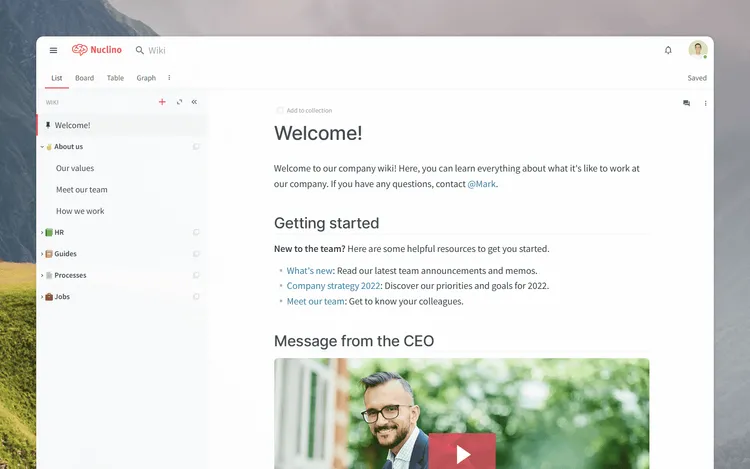
Here's an example of a company wiki created in Nuclino:
Company wiki vs. knowledge base, intranet, and shared drive
Several types of tools can store internal information, and the terminology often overlaps. The clearest distinction is usually the role each one plays in day-to-day work.
| Tool | Main purpose | Typical content |
|---|---|---|
| Company wiki | Sharing and maintaining internal company knowledge | Processes, policies, team documentation, guides, decisions |
| Knowledge base | Keeping structured reference information in one place | FAQs, documentation, troubleshooting guides, support material |
| Intranet | Sharing company-wide information and internal resources | Announcements, directories, news, calendars, links to internal services |
| Shared drive | Storing and organizing files | Documents, spreadsheets, presentations, PDFs, images |
The boundaries aren't strict. A company may use its wiki as an internal knowledge base, while an intranet may contain extensive documentation. Modern knowledge sharing tools can also cover several of these needs in the same system.
The practical question is whether employees can find reliable information easily, understand how it relates to other knowledge, and keep it current as the company changes.
Why use a company wiki?
The main benefit of a company wiki is simple: people can find information without having to know who to ask.
That becomes increasingly useful as the company grows. More employees create more processes, decisions, documents, and conversations that others may need later.
Keep company knowledge in one place
Without a shared system, different teams often develop their own ways of storing information. Marketing may rely on documents, engineering may keep useful context in GitHub and chat, HR may have a shared drive, and individual employees may keep their own notes.
A wiki gives everyone a common place to start. Specialized tools can still hold the files and data they handle best. The wiki can explain where information lives, provide context, and connect related resources.
Employees spend less time trying to remember which tool contains the answer and are less likely to rely on an outdated copy of a document.
Reduce repeated questions
Many internal questions come up again and again. Someone needs to know how to submit an expense, where to find brand assets, what an internal term means, who owns a process, or how a particular task should be handled.
Documenting those answers gives people a place to check before asking a colleague. It also takes some pressure off the employees who tend to become the default source for company knowledge.
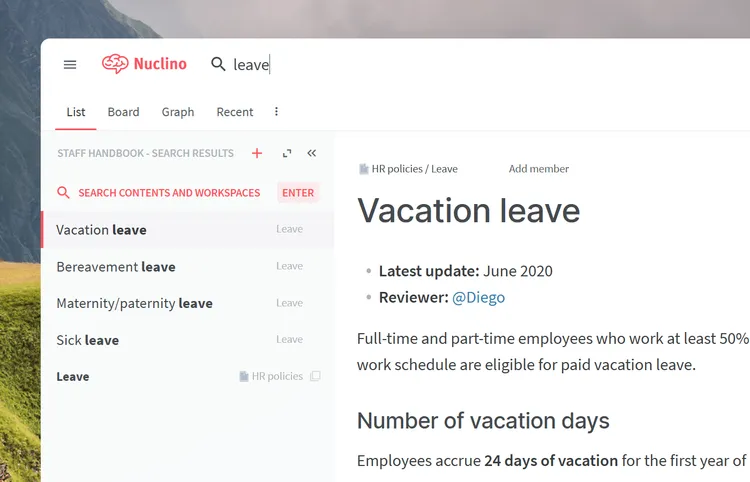
Search plays an important role here. Employees may know that an answer exists without remembering the title or location of the relevant item. Modern wiki platforms may also support AI-powered search. Nuclino's Sidekick, for example, can answer questions based on the knowledge documented in Nuclino.
Make onboarding easier
New employees usually have more questions than anyone else. They need to understand how the company works, where information lives, which tools people use, and who handles different responsibilities.
A well-organized wiki gives them somewhere to explore independently and return to whenever they need help. It can also reduce the amount of repeated explanation required during the employee onboarding process.
Documentation doesn't replace conversations with colleagues. It gives new hires useful context before those conversations and gives them something to refer back to later.
Keep useful knowledge in the company
Experienced employees accumulate context over time. They know why a process works a certain way, how unusual situations get handled, and what the team learned from earlier mistakes.
Some of that knowledge can disappear when responsibilities change or someone leaves the company. Documenting important processes, decisions, and lessons gives current and future employees a record they can refer to.
It can also make employee training easier when somebody takes over an existing responsibility.
What should a company wiki include?
There is no fixed set of items every company needs. A useful wiki should reflect how your company works and the information employees regularly need to find.
Most company wikis end up covering a few common areas.
Company information and policies
Start with information that people across the company may need. That can include your mission, strategy, organizational structure, team responsibilities, important tools, and common company terminology.
Policies and employee resources also fit naturally here. Your wiki may contain an employee handbook, time-off policy, expense guidelines, benefits information, security rules, and other HR policies and procedures.
Keeping these resources together gives employees an obvious place to check when they have a company-wide question.
Processes and how-to guides
Recurring work is worth documenting when several people need to follow the same steps or questions about the process keep coming up.
Your wiki might contain standard operating procedures, process documentation, approval workflows, or instructions for common tasks. A sales team could document its lead handoff process, while HR might maintain hiring procedures and instructions for managers.
Start with processes people use regularly. Those are usually the easiest places to see an immediate benefit.
Team knowledge
Individual teams will have information that deserves its own place in the wiki.
Marketing might maintain messaging guidelines, campaign processes, and channel documentation. Engineering may document technical decisions and development practices. Product teams can keep research, specifications, and decision records. Sales may maintain qualification criteria, handoff procedures, and answers to common customer questions.
Shared access to this information also helps people understand work happening outside their own team.
Onboarding and training
Onboarding pulls together information from across the company, so a wiki works well as a starting point for new employees.
You might include an onboarding checklist, first-week guidance, account setup instructions, training materials, introductions to different teams, and links to the policies and processes a new hire will use most often.
Role-specific onboarding can live alongside general company guidance, giving new hires a clear path through the information relevant to them.
Templates and shared resources
Frequently reused material should also be easy to find. Meeting note templates, project briefs, decision records, checklists, brand assets, and planning documents can live alongside the guidance that explains when and how to use them.
Keeping reusable resources in predictable locations also reduces the number of duplicate templates that tend to accumulate in personal folders and shared drives.
How to structure a company wiki
A useful structure should make it reasonably obvious where someone should look and where new information belongs. You don't need a complicated hierarchy to achieve that.
Start with a few broad sections
Most teams can begin with five or six top-level areas. For example:
- Start here: company overview, employee directory, important tools, and new-hire guidance
- Company: mission, values, strategy, goals, and common terminology
- People and policies: handbook, benefits, time off, expenses, and HR information
- How we work: communication guidelines, meetings, recurring processes, and decision-making
- Teams: documentation maintained by Marketing, Product, Engineering, Sales, and other functions
- Resources: templates, brand assets, FAQs, and frequently used reference material
A smaller company may need fewer sections. The goal is to create enough structure for people to orient themselves without forcing every item into a detailed hierarchy.
Keep the hierarchy shallow
Several layers of nested categories can make information harder to find. A structure may feel perfectly logical to the person who created it and much less obvious to everyone else.
Keep broad categories near the top and add another level when a section genuinely becomes difficult to navigate. Internal links and search can handle many relationships that don't fit neatly into a folder-like structure.
Use clear, familiar names
Section and item names should match the language people already use inside the company.
Straightforward labels such as "Policies," "Marketing," "Onboarding," and "Expenses" are easy to recognize. Descriptive item titles also make search results easier to scan.
Connect related items
The hierarchy gives the wiki its basic shape, while internal links help employees move between related topics.
An onboarding item might link to policies, team introductions, and tool instructions. A process can point to the relevant template. A project retrospective can link back to the original brief and decisions.
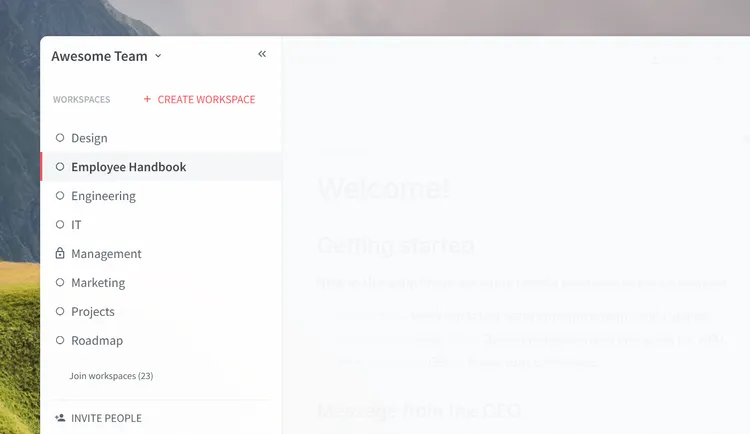
In Nuclino, broad areas can live in separate workspaces, with related items organized into collections and sub-collections.
You can also use a company wiki template as a starting point and adjust the structure to match your team.
How to build a company wiki
You can launch a useful company wiki without turning it into a large documentation project. Start with the information your team already needs and improve the wiki as people use it.
Step 1: Decide what the wiki should solve
Start by identifying the problems you want the wiki to solve. New hires may struggle to find basic information, employees may encounter several versions of the same process, or your team may rely on a few experienced colleagues whenever someone has a question. Knowing where the biggest gaps are will help you decide what to document first.
Think about who needs the wiki most as well. A wiki created primarily for new hires may need more background and guidance, while one used mainly by experienced teams can focus more heavily on processes, decisions, and reference material.
Keep the initial scope manageable. Every file, chat message, and meeting note doesn't need a permanent place in the wiki. Focus on information people are likely to need again, especially knowledge that currently causes repeated questions or gets lost across different tools.
Step 2: Plan the initial structure
Choose a few broad sections before adding a large amount of content. Use categories that already make sense inside your company, such as People, Processes, Teams, Onboarding, and Resources.
You don't need to anticipate every future item. The structure only needs to support the first useful set of information. An obvious starting item can help orient people as well. It can introduce the wiki, point to the main sections, and surface frequently used resources.
Step 3: Choose your company wiki software
The software has a direct impact on how willing people will be to maintain the wiki. If editing feels cumbersome or search regularly fails to find the right information, employees will gradually stop using it.
A good wiki tool should cover the essentials:
- Fast and reliable search
- Simple editing
- Clear navigation and internal links
- Permissions and access controls
- Version history
- Import and export options
- Integrations with tools your team already uses
AI-powered search can also be useful once the wiki contains a larger amount of information, particularly when employees know the answer exists but don't know where to look.
Try any tool you're considering with real company content. Create an onboarding guide, a process, and a policy item. Search for them the way an employee would and ask a few colleagues to make edits. That gives you a much better sense of the everyday experience than comparing feature lists.
Nuclino, for example, combines docs, wikis, projects, and collaborative whiteboards in one lightweight workspace. It includes internal links, search, permissions, version history, and AI-powered answers while keeping the editing experience simple.
Step 4: Create the first useful content
You don't need to document the entire company before launching the wiki. Begin with material employees already ask for or use frequently.
A useful first version might include:
- An employee handbook
- An onboarding guide
- A few important processes
- Frequently used templates
You can add tool instructions, company terminology, FAQs, and team-specific documentation as the wiki grows. Leave one-off notes, unfinished drafts, and rarely used reference material out of the initial wiki unless there is a clear reason people will need them again.
Starting with a smaller set of genuinely useful content also gives you a clearer picture of what people actually need. Search behavior and recurring questions will quickly reveal gaps worth filling.
Step 5: Bring over existing documentation carefully
Most companies already have useful material in Google Docs, Word files, shared drives, older wiki software, or other systems. Review that content before moving it.
Keep material that is still useful, combine duplicates, and leave outdated documents behind. Moving everything without review can recreate the same clutter that made the previous setup difficult to use.
Large documents may also work better when split into smaller items. A long operations manual is difficult to link to precisely and harder to keep current. Individual items for important processes give employees a direct route to the information they need.
If you're moving to Nuclino, you can import existing content and organize it alongside newly created items.
Step 6: Connect related knowledge
Internal links help turn a collection of documents into a wiki.
An onboarding guide can link to the expense policy and communication guidelines. A campaign process can point to brand assets and templates. A technical decision can link to the project or research that led to it.
These connections give employees useful context and create additional paths through the wiki beyond the main hierarchy.
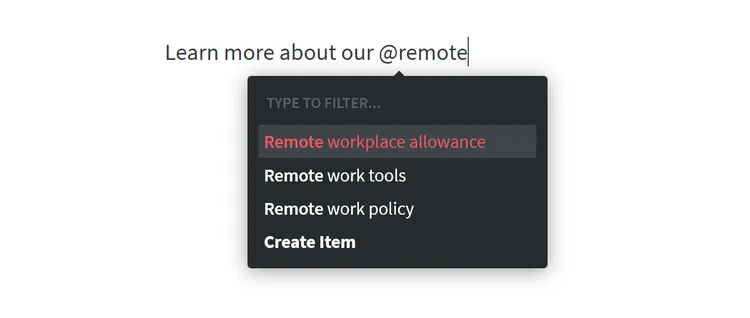
In Nuclino, you can create an internal link by typing "@" and selecting another item.
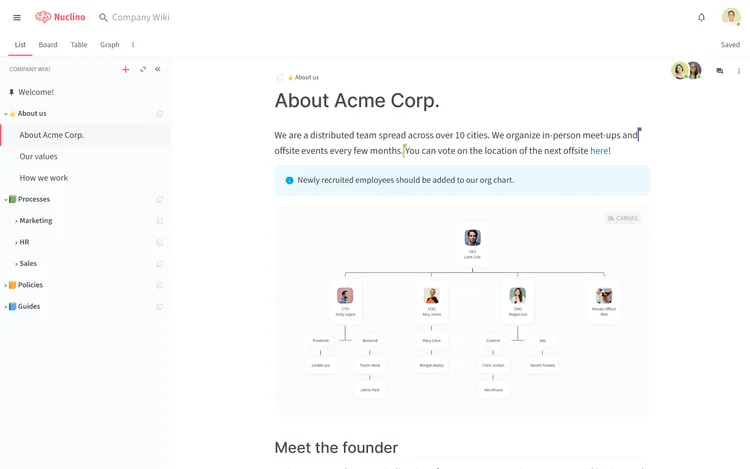
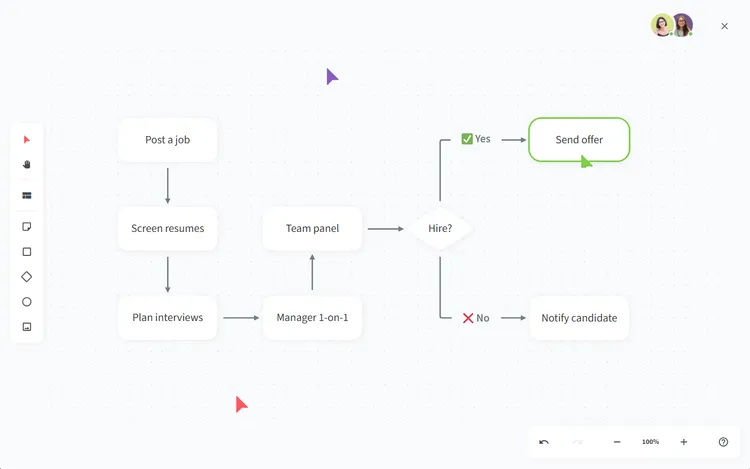
Some information also works better visually. Screenshots can clarify software instructions, while diagrams and flowcharts can explain processes with several steps or participants.
Nuclino lets you add a collaborative canvas to an item when a visual format is useful.
Step 7: Set permissions, ownership, and expectations
Once the initial content is in place, decide how people will access, edit, and maintain it.
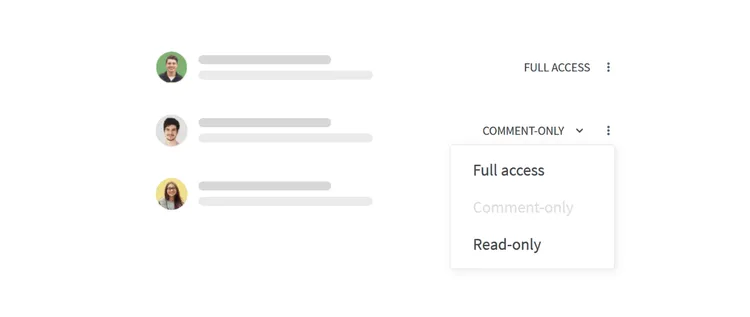
Permissions. General company knowledge should usually be easy for employees to access. HR, finance, legal, and management documentation may need tighter controls. Editing permissions can also vary depending on the type of content.
Ownership. Important information should have someone responsible for keeping it accurate. HR might own the employee handbook, while individual teams maintain their own processes and guidelines. The owner doesn't have to make every edit personally. They simply need to notice when the content no longer reflects how the company works.
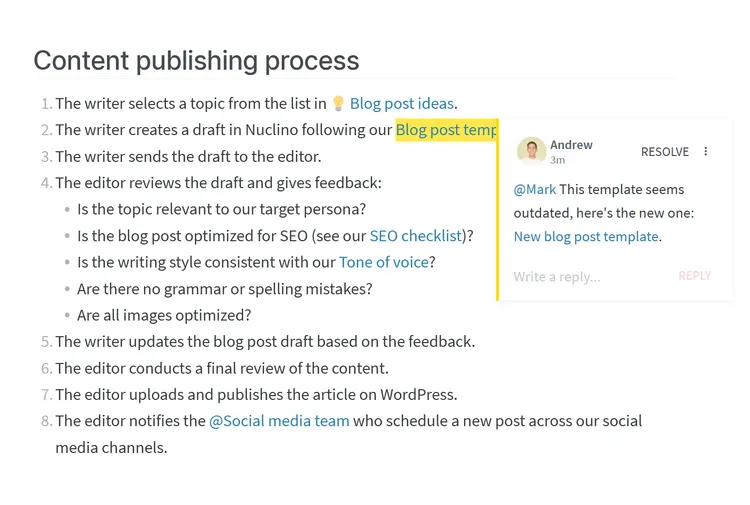
Adoption. Show employees where the wiki lives, how it is organized, and how they can contribute. Then use it during normal work. Share a wiki link when someone asks a question that already has an answer. Update the relevant item when a process changes. Add missing information when a useful question exposes a gap.
These small habits matter more than a large launch announcement. People begin to search the wiki first once they learn that useful answers are likely to be there.
After launch, look for signs that the wiki is actually helping. New hires should be able to answer more questions on their own, frequently used processes should get referenced during everyday work, and repeated questions should become less common. If people still struggle to find information, that usually points to a problem with the structure, search, or documentation itself.
How to keep your company wiki up to date
A wiki loses value quickly when employees stop trusting its contents. Regular maintenance doesn't require a dedicated documentation team, but it does need clear responsibilities and a few consistent habits.
Assign owners to important content
Give important items an owner based on the subject. HR can take responsibility for employee policies, IT can maintain security guidance, and individual teams can own their processes and working documentation.
Clear ownership also gives employees someone to contact when they notice missing or incorrect information.
Update documentation when the work changes
Small updates are easiest to make while the details are still fresh.
If your expense process changes, update the relevant item. If the team adopts a new meeting format, revise the meeting guidelines. When a discussion changes how a process works, capture the result while everyone still remembers the context.
Keeping documentation close to the work reduces the need for large cleanup projects later.
Review critical information regularly
Some content needs more attention than others. Policies, security procedures, onboarding instructions, and frequently used operational processes are good candidates for periodic reviews.
Other reference material may not need a fixed review schedule. Employees can update it when they use the information and notice that something has changed.
Archive outdated and duplicate content
Old information can cause real confusion when employees follow it without realizing that it no longer applies.
Archive items that no longer serve a purpose, merge duplicates, and remove old instructions once a new process replaces them. A smaller collection of trustworthy information is easier to search and maintain.
Repeated questions can also reveal maintenance problems. If several people ask about something that is already documented, the answer may be difficult to find, unclear, or out of date.
Common mistakes to avoid
Even a well-planned wiki can become difficult to use over time. Most problems come down to scope, structure, ownership, and everyday habits.
Trying to document everything before launch
A large documentation project can lose momentum before employees see much value from it. Start with the information people already need, launch the wiki, and add more as genuine gaps appear.
Making the structure too complicated
Deep hierarchies become difficult to understand as the wiki grows. Keep the top level broad and predictable, use descriptive titles, and rely on internal links and search when information doesn't fit neatly into one category.
Leaving important content without an owner
Documentation ages when nobody feels responsible for it. Assigning ownership gives important content a better chance of staying accurate without creating a centralized documentation team.
Making every edit difficult
Strict approval workflows can discourage people from correcting small mistakes or adding useful context. Use tighter controls where the information requires them and keep everyday documentation easy to improve.
Keeping duplicate versions of the same information
Two items that describe the same process can quickly contradict each other. Choose one authoritative source and link to it wherever employees need the same guidance.
Treating the wiki as finished
Your company will keep changing. Teams reorganize, tools change, new employees join, and processes improve. The wiki needs regular small updates to stay useful alongside that work.
When does a company need a wiki?
You don't need hundreds of employees before a company wiki becomes useful. Even a small team can benefit once people regularly share knowledge, repeat processes, or depend on particular colleagues for information.
Common signs include:
- The same questions keep appearing in chat.
- New hires rely heavily on repeated explanations.
- Employees struggle to find the current version of a process or policy.
- Important knowledge lives in personal notes or old conversations.
- Different people follow different versions of the same process.
- A few experienced employees have become the default source for answers.
Remote and hybrid teams may notice these problems earlier because informal knowledge doesn't travel as easily when people work in different places or on different schedules.
Starting while the company is still relatively small can make the wiki easier to maintain. You can document useful information as it appears and develop good habits before years of files and conversations accumulate.
A company wiki doesn't have to become a huge internal encyclopedia. It needs to give employees a dependable place to find the information they use, understand how the company works, and contribute what they know.
Start with a clear structure and a small set of useful content. Keep ownership close to the people who understand each subject, and improve the wiki whenever your team finds something missing or outdated.