Coda and Notion overlap across docs, databases, and project tracking, but they are built around different priorities. Notion puts writing and organization first. Coda gives formulas, connected tables, buttons, and automations a much bigger role, making it better suited to workflows with more custom logic.
That core difference remains, although both products have changed quite a bit over the last year. Coda was acquired by Grammarly in 2025 and became part of the Superhuman suite later that year. In July 2026, it was renamed Superhuman Docs, alongside new pricing and a rebuilt AI experience. Notion has also expanded its databases, automations, and AI features.
The better choice mainly comes down to how much structure and customization you need. Below, we compare their features, pricing, ease of use, and overall strengths to help you decide which app is a better fit.
How we compared Coda and Notion
We based this comparison on three sources:
- Hands-on testing: We set up comparable workspaces in both products. We created and organized docs, built databases with multiple views and connected data, set up formulas and automations, shared content with other users, and tested permissions and navigation.
- Official documentation: We checked current pricing, billing rules, plan limits, permissions, AI features, and other details that can change over time.
- User feedback: We reviewed recent discussions on Reddit and reviews on G2 and Capterra, with particular attention to recurring complaints around performance, complexity, pricing, and reliability.
All pricing and product information in this article was checked in October 2026.
Coda vs Notion at a glance
| Coda / Superhuman Docs | Notion | |
|---|---|---|
| Best fit | Data-heavy workflows and interactive internal tools | Docs, wikis, and flexible workspaces |
| Ease of use | More setup and a steeper learning curve for advanced workflows | Easier to get started with for docs and basic structured work |
| Writing and docs | Good, with interactive elements embedded throughout | Better suited to writing and nested documentation |
| Tables and formulas | More flexible formula language and table logic | Strong databases with relations, formulas, and multiple views |
| Automations | Deeply integrated with formulas, buttons, Packs, and tables | Native database automations, buttons, webhooks, and form automations |
| AI | Docs AI included for paid Doc Makers during beta | Full Notion AI on Business and Enterprise |
| Integrations | Packs can sync data and take actions in external tools | Native connections, API, webhooks, and third-party automation |
| Offline access | Already-open docs remain editable after losing connection | Pages can be downloaded before going offline |
| Pricing | Free; Pro $12/Doc Maker/month; Business $33/Doc Maker/month (annual billing) | Free; Plus $10/member/month; Business $20/member/month (annual billing) |
Coda vs Notion key differences
Ease of use and setup
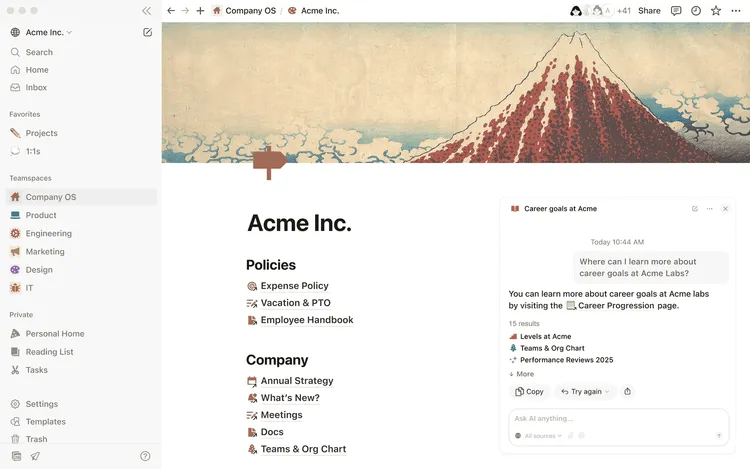
Notion is quicker to get started with for docs, wikis, and basic project tracking. In our test workspace, we could create a usable structure with pages and databases without much configuration. The interface also stays fairly consistent as you move between docs and database views.
Coda has more concepts to learn once you move beyond basic docs. Tables, views, buttons, controls, formulas, and Packs can all interact, and setting up the same kind of structured workflow involved more configuration in our test. That extra complexity also gives Coda more room for custom logic.
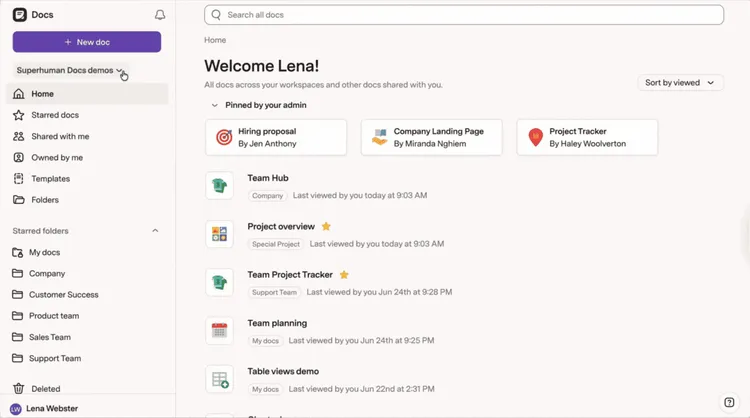
Notion has the advantage if you want to start organizing information quickly. Coda gives you more control if you are prepared to spend more time building the workflow.
Docs and knowledge management
Notion remains the easier fit for writing-heavy work. Pages can be nested deeply, linked throughout a workspace, and organized into dedicated wikis. Wiki pages can also have owners and verification dates.
Coda uses pages too, but the canvas is more tightly connected to structured data. Tables, controls, buttons, and calculated values can sit directly beside normal text. A document can gradually become an interactive workflow without leaving the page.
That difference shows up in recent user comparisons as well. People using Coda for relational or computational work tend to value its flexibility, while users focused mainly on writing still tend to prefer Notion.
Tables, formulas, and databases
Coda gives formulas a wider role across the product. They can calculate table values and run directly on the canvas. The same formula language can also drive buttons and automations.
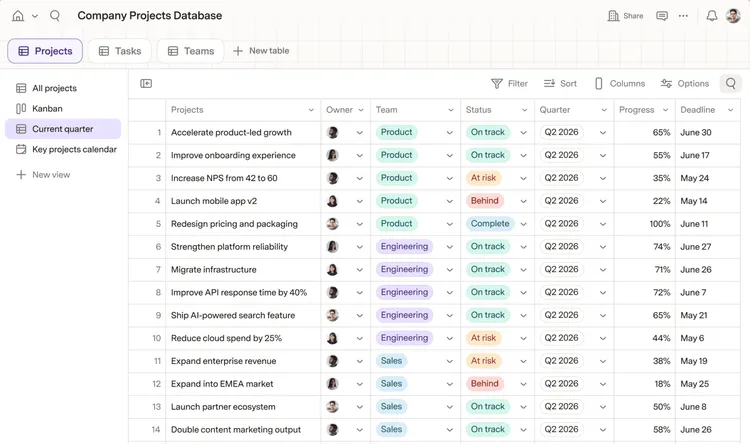
Notion formulas have become considerably more capable over time. They can be used in database properties, button actions, and database automations. Notion also supports relations, rollups, dependencies, and multiple database views.
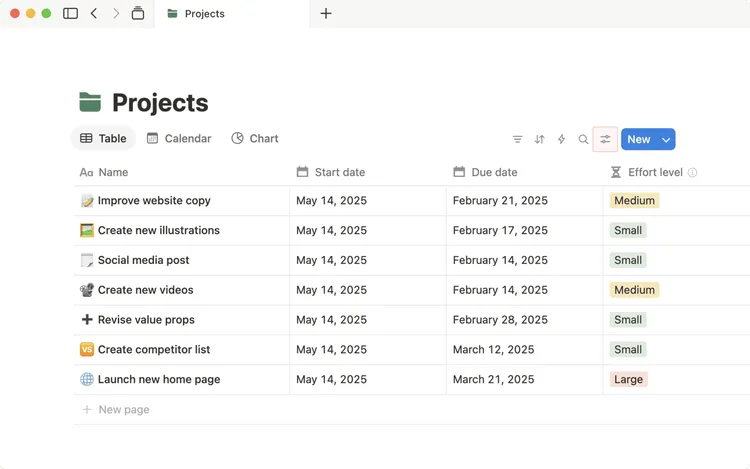
A recent user moving a Notion setup to Coda highlighted formula queries across tables and the ability to use formulas outside database tables as two of Coda's advantages.
Automations and integrations
Both products now have meaningful native automation features.
| Capability | Coda / Superhuman Docs | Notion |
|---|---|---|
| Native workflow automations | Yes | Yes, on paid plans |
| Buttons | Can run formulas and actions | Can update databases and trigger actions |
| External actions | Packs and webhook-triggered workflows | Webhooks, connections, and API |
| Forms | Connected directly to tables | Connected directly to databases |
Coda automations can react to row changes or form submissions. They can also run on a schedule or through a webhook. Actions can edit table data, press buttons, or call Pack actions.
Notion has closed some of the old gap. Paid users can create database automations, and formulas can now be used inside automation actions. Forms can trigger workflows too.
Coda still gives formulas and Packs a more central role in the automation model. Notion is easier to follow when the workflow stays close to database properties and page actions.
Notion AI vs Coda AI
Coda AI has changed more than most current comparison pages reflect. After Coda became Superhuman Docs, the old Coda AI credit system was paused and replaced by Docs AI during its current beta.
| Docs AI / Coda AI | Notion AI | |
|---|---|---|
| Free access | Limited trial | Limited trial on Free and Plus |
| Paid access | Included for paid Doc Makers during beta, subject to fair use | Included on Business and Enterprise with usage allowances |
| Workspace building | Can build pages and trackers; AI Views are in beta | Notion Agent can create and work with workspace content |
| Additional AI usage | Previous Coda AI credit packages are paused during beta | Custom Agents and premium models can use Notion credits |
Paid Superhuman Docs users currently get Docs AI with generous beta limits. MCP is also available to paid Doc Makers, allowing external assistants such as ChatGPT or Claude to work with Docs content.
Notion AI is fully available on Business and Enterprise. Notion currently has the broader agent layer, with Notion Agent built into Business and Custom Agents available through its credit system.
Mobile and offline use
Notion has the clearer offline setup. Desktop and mobile users can download individual pages before losing their connection. Paid plans automatically download recently visited and favorited pages as well.
Superhuman Docs can continue working offline after a doc has already been loaded. You need an internet connection to open it initially, and refreshing or closing the page means you cannot reopen that doc until the connection returns.
Mobile editing is also more limited in Superhuman Docs. You can read and edit content, add table rows, comment, and create docs. Formula editing and changes to table display still require a computer.
If you regularly work without a reliable connection or do substantial editing on a phone, Notion currently has the advantage.
Coda vs Notion pricing
The headline prices do not tell the full story because the products charge for different types of users.
| Plan | Coda / Superhuman Docs | Notion |
|---|---|---|
| Free | $0 | $0 |
| First paid plan | Pro: $12/Doc Maker/month | Plus: $10/member/month |
| Business | $33/Doc Maker/month | $20/member/month |
| Enterprise | Custom pricing | Custom pricing |
The prices above use annual billing and reflect the current public plans for new customers.
Coda uses Maker billing. Doc Makers are paid seats, while Editors and Viewers are free. An Editor can change existing docs and pages but cannot create new ones. Creating docs or using Docs AI beyond the trial requires Doc Maker access.
Notion charges for workspace members. Guests remain free but only get access to content shared with them.
That can produce a large difference when only a few people need to build the system. A 10-person workspace with two Doc Makers would pay $24/month for Superhuman Docs Pro at annual pricing. Ten Notion Plus members would cost $100/month. The comparison changes if most people need Doc Maker rights or can work as Notion guests.
Existing Coda customers have another wrinkle. Superhuman says customers who stayed on their existing Coda subscription can keep their existing plan and pricing after the rename.
For more detail on Notion's current plans, see our Notion free vs paid comparison and 2026 Notion pricing changes.
Which should you choose, Coda or Notion?
Choose Coda / Superhuman Docs if
- Your workflows depend heavily on formulas, buttons, automations, and connected tables.
- A small number of people build the system while a larger group edits or reads it.
- You want Packs to pull external data into the same interactive docs.
- You frequently build trackers or internal tools rather than mainly writing documentation.
Choose Notion if
- You spend more time writing docs or maintaining a company wiki.
- You want pages and databases to feel consistent across many different use cases.
- Offline access and mobile editing are important.
- Most people need the same creation rights and a straightforward per-member plan.
- Notion Agent and the wider Notion AI ecosystem are a major part of the decision.
A simpler alternative to Coda and Notion
Nuclino is a simpler, faster alternative to Coda and Notion, with less setup and a much shorter learning curve. It combines docs, wikis, projects, and collaborative whiteboards in one lightweight workspace.
Compared with Coda and Notion, Nuclino keeps the feature set more focused:
- Project management: Nuclino supports lightweight project tracking with boards, fields, and assigned tasks.
- Whiteboards: The built-in canvas supports diagrams, brainstorming, and other visual collaboration.
- AI: Nuclino can search across workspace content, summarize information, and assist with writing.
- MCP: Compatible AI assistants can work with Nuclino content through its MCP server while respecting existing permissions.
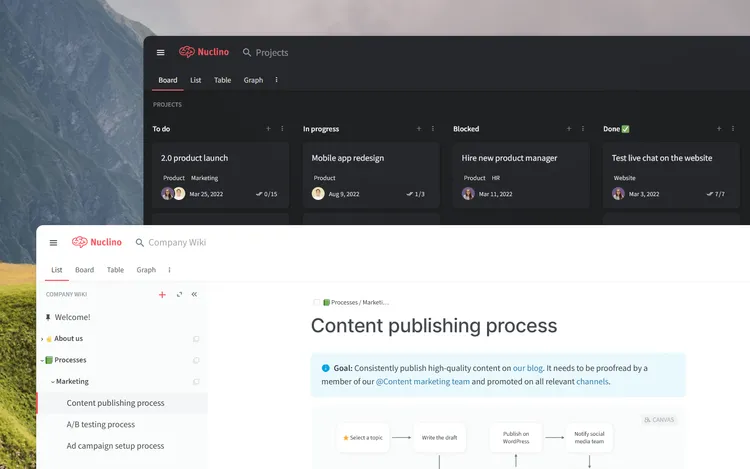
Nuclino doesn't offer the same database depth, formulas, or workflow customization as Coda and Notion. It's a better fit for teams that don't need those advanced features and want something easier to set up and maintain.
You can also browse more Coda alternatives or Notion alternatives.
Coda vs Notion FAQ
Is Coda still available after the Superhuman Docs rename?
Yes. Coda became Superhuman Docs on July 8, 2026. Existing accounts, docs, and workspaces carried over. The product now uses the Superhuman Docs name and branding.
Does Coda charge for editors?
No. Superhuman Docs charges for Doc Makers. Editors and Viewers are free. Editors can work inside existing docs but cannot create new docs or pages.
Is Coda cheaper than Notion?
It can be, especially when only a small number of people need Doc Maker access. At annual pricing, 10 Notion Plus members cost $100/month, while two Coda Pro Doc Makers cost $24/month and the remaining Editors and Viewers can be free.
The difference becomes smaller if most people need Doc Maker access or can work as guests in Notion.
Which is better for docs, Coda or Notion?
Notion is generally the better fit for writing, nested documentation, and wiki-style knowledge management. Coda becomes more compelling when the document needs substantial table logic, formulas, or interactive controls.
Which is better for formulas and automations?
Coda gives formulas a broader role across tables, buttons, controls, and automations. Notion now has native formulas and database automations as well, but Coda still gives users more freedom to build calculation-heavy workflows.
Can Coda and Notion work offline?
Both have offline support, but the behavior differs. Notion lets you download pages ahead of time. Superhuman Docs keeps an already-open doc editable after the connection drops, but you cannot initially open a doc without internet access.
How do Coda and Notion compare with Airtable and ClickUp?
Airtable is more focused on structured data and database-driven workflows, while ClickUp puts project and task management at the center. Coda and Notion cover a broader mix of documentation, collaboration, and structured work.
Airtable is a stronger option if much of your work revolves around relational data and custom interfaces. ClickUp is better suited to more dedicated project management. Coda sits closer to Airtable in its approach to tables and formulas, while Notion puts more emphasis on docs and wikis.